

A good desk lamp can make long study sessions, paper reading, note-taking, and late-night research much more comfortable.
Finding the best desk lamps for graduate students depends on your desk size, study habits, and how much control you want over brightness and color temperature.
Graduate students often use the same desk for several different tasks: reading printed papers, writing notes, working on a laptop, joining video meetings, and sometimes working late into the evening. A desk lamp that lets you control brightness, color temperature, and light direction can therefore be more useful than a simple fixed lamp.
For this guide, I compared five desk lamps across different price ranges, focusing on brightness, adjustability, desk space, lighting controls, build design, and features that are genuinely useful for graduate students.
If you are also improving your desk ergonomics, see our guide to the best laptop stands for graduate students.
Disclosure: This post contains affiliate links. If you buy through one of these links, GradToolLab may earn a commission at no additional cost to you.
Table of Contents
Quick Comparison
| Product | Best For | Brightness | Color Control | Standout Feature |
|---|---|---|---|---|
| Honeywell H01 Pro | Best Overall | 500 lm | 3 color temperatures | USB-A + USB-C charging |
| Lepro LED Desk Lamp 800LM | Best Budget | 800 lm | 5 color temperatures | Strong value and flexible lighting |
| OttLite Organizer LED Desk Lamp | Best for Small Desks | 440 lm | Brightness adjustment | Built-in storage compartments |
| Lume Cube Edge 2.0 | Best for Video Calls | 700 lm | 2700K–7500K | Converts into a face light |
| Daylight Slimline 4 | Best for Large Desks | 1,000 lm | 6000K | Wide illumination and clamp mounting |
1. Honeywell H01 Pro — Best Overall
The Honeywell H01 Pro is the most balanced desk lamp in this comparison for general graduate-school use.
It provides up to 500 lumens and uses a full-spectrum LED light source with a CRI of 95 or higher. It supports three color-temperature settings—3000K, 4000K, and 5500K—along with stepless brightness adjustment.
That gives you enough flexibility to use warmer light for relaxed evening work, a neutral setting for general desk use, and cooler light when you want a brighter-looking workspace.
The H01 Pro also includes both USB-A and USB-C charging ports, so you can charge a phone or another small device without using an additional wall outlet. For a crowded graduate-student desk, that is a genuinely useful addition rather than just a specification-sheet feature.
The lamp can also be folded and adjusted at multiple angles. Honeywell states that its compact folding design can reduce the lamp’s desk footprint by up to 70% when folded.
Its light is specified as flicker-free, and the lamp uses an RG0 blue-light hazard classification. Rather than treating that as a guarantee against fatigue, the more practical benefit is that it is designed for long-duration task lighting without visible flicker.
At around the $40 range on Amazon at the time of writing, it sits comfortably between budget lamps and premium professional lighting.
Pros
- CRI ≥95
- 500-lumen output
- Three color temperatures
- Stepless brightness adjustment
- USB-A and USB-C charging
- Foldable design
- Multi-angle adjustment
- Flicker-free lighting
Cons
- Not as bright as the Lepro or Daylight models
- Only three color-temperature settings
- Requires a desk surface for its base
Best for: Most graduate students who want one flexible lamp for reading, writing, computer work, and everyday desk use.
Price: Check current price on Amazon
2. Lepro LED Desk Lamp 800LM — Best Budget
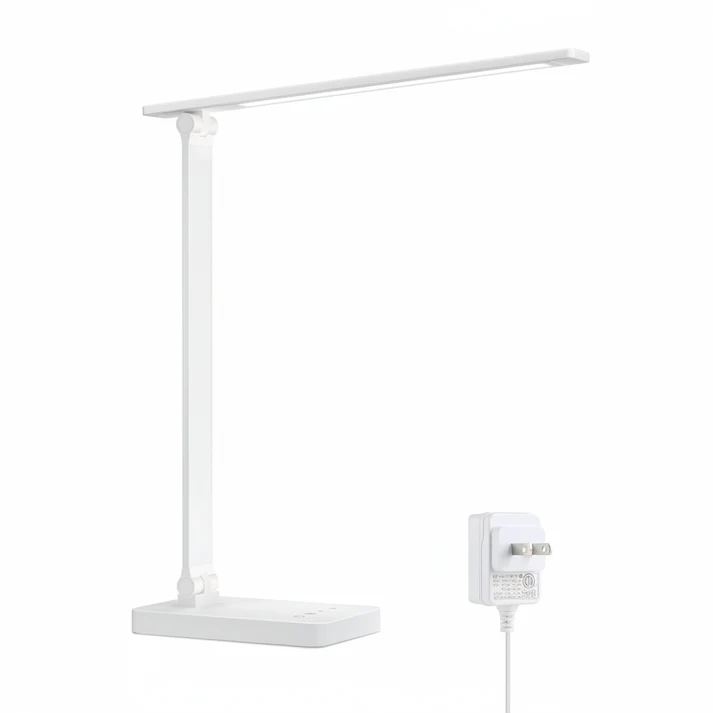
Image courtesy of Lepro
The Lepro LED Desk Lamp 800LM is the strongest value option in this comparison.
Despite being the least expensive lamp here, it provides up to 800 lumens and offers five color-temperature settings:
- 3000K
- 3500K
- 4000K
- 5000K
- 6500K
It also includes five brightness levels.
That gives you considerably more lighting flexibility than many inexpensive fixed-color lamps.
The lamp head and arm can be repositioned, and its simple rectangular design works well on a study desk without drawing much attention to itself.
For graduate students, the strongest argument for this model is simply value. At roughly the $25–$30 range on Amazon at the time of writing, you get adjustable brightness, adjustable color temperature, and relatively high maximum output without spending much.
It does not provide the premium materials or advanced positioning of the more expensive lamps in this guide, and there are no integrated charging ports on this particular version.
But if your goal is simply to illuminate papers, notebooks, textbooks, and a keyboard clearly, the feature set is difficult to argue with at this price.
Pros
- Affordable
- Up to 800 lumens
- Five color temperatures
- Five brightness levels
- Adjustable lamp position
- Compact, simple design
- Good range of lighting options for the price
Cons
- Mostly plastic base construction
- No integrated USB charging on this version
- Less premium design than more expensive alternatives
Best for: Students who want an inexpensive but highly adjustable lamp for studying and reading.
Price: Check current price on Amazon
3. OttLite Organizer LED Desk Lamp — Best for Small Desks
The OttLite Organizer LED Desk Lamp solves a slightly different problem: keeping a small study desk organized.
The lamp incorporates built-in storage compartments at the base, giving you somewhere to keep pens, highlighters, scissors, or other small study supplies.
That can be particularly useful in a dorm room, small apartment, or shared office where desk space is limited.
The lamp provides four brightness settings and a maximum output of 440 lumens. Its flexible neck allows the light to be repositioned, while the integrated diffuser is designed to produce a more uniform light across the workspace.
The organizer section measures approximately 5 × 4.25 inches, and the lamp height can be adjusted from roughly 11.75 to 24.75 inches.
That makes it quite different from the other options in this article. Rather than maximizing brightness or advanced lighting controls, it combines two pieces of desk equipment into one.
The limitation is that this particular model does not offer multiple color temperatures, and its 440-lumen maximum output is lower than most of the other lamps here.
Still, for a compact workspace, organization may matter more than maximum output.
Pros
- Integrated storage compartments
- Four brightness levels
- Flexible neck
- Up to 440 lumens
- Compact footprint
- Useful for pens, markers, and other study supplies
Cons
- No adjustable color temperature
- Lower maximum output than most alternatives
- Design prioritizes storage over advanced lighting features
Best for: Students with small desks who want to combine task lighting and desk organization.
Price: Check current price on Amazon
4. Lume Cube Edge 2.0 — Best for Video Calls
The Lume Cube Edge 2.0 is the most unusual lamp in this guide because it can function as both a desk lamp and a video-conference light.
It provides up to 700 lumens, has a CRI rating of 95+, and allows the color temperature to be adjusted from 2700K to 7500K.
That is the widest color-temperature range among the five lamps here.
The circular lamp head can rotate, allowing you to illuminate your desk during normal work and then reposition the light toward your face for Zoom, Teams, online interviews, presentations, or remote teaching.
Lume Cube specifically designed the rotating head to support video conferencing and streaming use.
This makes it especially interesting for graduate students who already use a dedicated webcam and microphone.
Instead of buying a desk lamp and a separate video light, you can potentially cover both roles with one device.
For a complete video-call setup, you may also want to compare the best webcams for graduate students.
Clear lighting helps on camera, but a dedicated USB microphone can also improve the quality of online presentations and meetings.
The Edge 2.0 also offers extensive arm adjustment and a wide brightness range. The version we found on Amazon uses a weighted base, which makes it easy to reposition without attaching anything permanently to the desk.
The major disadvantage is price. At around $150, it costs several times more than a basic student desk lamp.
If you rarely join video calls, its additional flexibility probably does not justify that cost. But if video meetings, interviews, remote teaching, or recorded presentations are a regular part of your work, the dual-purpose design becomes much more compelling.
Pros
- Up to 700 lumens
- 95+ CRI
- Very wide 2700K–7500K color range
- Adjustable brightness
- Rotating circular head
- Works as a video-call light
- Highly adjustable arm
Cons
- Expensive
- Overkill if you only need basic study lighting
- Takes up more vertical space than a compact desk lamp
Best for: Graduate students who frequently participate in video meetings, online teaching, interviews, or recorded presentations.
Price: Check current price on Amazon
5. Daylight Slimline 4 — Best for Large Desks
If you work across a large desk covered with papers, books, a keyboard, and research materials, the Daylight Slimline 4 is designed for a different scale of workspace.
It produces up to 1,000 lumens and reaches 3,200 lux at 30 cm at its highest setting. It provides four brightness levels and uses 6000K LEDs with a CRI of 95+.
Its long horizontal light head spreads illumination across a wider section of the desk than a small conventional lamp.
That can be particularly useful when you are comparing multiple printed papers, annotating documents, drawing diagrams, working with electronics, or performing other tasks where illuminating only one notebook-sized area is not enough.
Instead of a conventional base, the Slimline 4 uses a 2-in-1 clamp and screwable tabletop mount. The maximum clamp opening is 55 mm.
This has an important advantage: a large lamp does not necessarily need to consume a large amount of desk surface.
It also includes a 5V/2A USB-C charging port.
However, the lighting controls are less flexible than some of the cheaper lamps in this guide. The Slimline 4 uses a fixed 6000K color temperature rather than offering warm and cool modes.
It is also expensive—around $230 on Amazon when we checked.
For basic reading, this would be excessive. But for a large research desk or a workspace where you regularly spread out documents and equipment, its wide illumination and clamp-mounted design offer something the smaller lamps do not.
Pros
- Up to 1,000 lumens
- 3,200 lux at 30 cm
- CRI 95+
- Wide light head
- Four brightness levels
- Clamp mounting preserves desk surface
- USB-C charging port
- Long reach
Cons
- Very expensive
- Fixed 6000K color temperature
- Clamp mounting may not work with every desk
- More lamp than most students need
Best for: Graduate students with large desks, multiple monitors, printed research materials, or detailed technical work.
Price: Check current price on Amazon
Which Desk Lamp Should You Choose?
For most graduate students, the Honeywell H01 Pro is the easiest choice to justify.
It gives you adjustable brightness, multiple color temperatures, good color rendering, charging ports, and a compact folding design without moving into premium pricing.
If your budget is limited, the Lepro LED Desk Lamp 800LM offers a surprising amount of control for the price, including five brightness settings and five color temperatures.
The OttLite Organizer LED Desk Lamp makes the most sense when desk space and organization are bigger concerns than maximum brightness.
If video meetings are an important part of your work, the Lume Cube Edge 2.0 offers something the other lamps do not: one light for both your desk and your face.
And if you have a large research workspace and need to illuminate papers, books, or equipment across a wide area, the Daylight Slimline 4 is the most capable option here.
Quick Recommendations
- Best overall: Honeywell H01 Pro
- Best budget: Lepro LED Desk Lamp 800LM
- Best for small desks: OttLite Organizer LED Desk Lamp
- Best for video calls: Lume Cube Edge 2.0
- Best for large desks: Daylight Slimline 4
What to Look for in a Desk Lamp for Graduate School
Brightness
Brightness is commonly measured in lumens.
A higher lumen rating does not automatically mean a lamp is better, because the direction and distribution of the light also matter.
For a small desk, 400–500 lumens may be enough.
A larger workspace containing multiple books, papers, or technical equipment can benefit from a brighter and wider light source.
The lamps in this guide range from approximately 440 lumens to 1,000 lumens.
Color Temperature
Color temperature is measured in Kelvin.
Lower values produce warmer, more yellow light, while higher values appear cooler and whiter.
As a rough guide:
- 2700K–3000K: warmer and more relaxed
- 4000K: neutral
- 5000K–6500K: cooler daylight-style illumination
A lamp with multiple color temperatures gives you more flexibility if the same desk is used both during the day and late at night.
The Lepro and Lume Cube models provide the widest range of adjustment in this comparison.
CRI
CRI stands for Color Rendering Index.
It describes how accurately a light source renders colors compared with a reference light source.
For ordinary note-taking, CRI is not usually a deciding factor.
However, higher CRI can be useful if your research or hobbies involve photography, graphics, samples, artwork, electronics, maps, or other tasks where distinguishing colors accurately matters.
The Honeywell H01 Pro, Lume Cube Edge 2.0, and Daylight Slimline 4 all specify CRI values of 95 or higher.
Adjustable Brightness
You probably do not need maximum brightness all the time.
A bright setting can be useful when reading detailed printed material, while a lower setting may be more comfortable when you are mostly working on a monitor.
All five lamps in this guide offer some form of brightness adjustment.
Desk Space
Graduate-student desks tend to accumulate equipment quickly.
A laptop, monitor, keyboard, mouse, notebooks, papers, chargers, headphones, and a microphone can leave surprisingly little free surface.
If your desk is already crowded, look at the shape of the base as carefully as the lamp itself.
The OttLite provides integrated storage, the Honeywell folds into a compact shape, and the Daylight Slimline 4 clamps to the desk instead of occupying a large section of the surface.
If your desk is already crowded with connected devices, a USB-C hub can help simplify your setup.
USB Charging
USB charging is convenient, but it should not be the main reason to choose a lamp.
The Honeywell H01 Pro includes USB-A and USB-C connections, while the Daylight Slimline 4 incorporates a USB-C charging port.
If your laptop already has limited ports, however, dedicated charging at the lamp can reduce the number of cables connected to your computer.
Desk Lamp vs. Monitor Light Bar
A desk lamp and a monitor light bar serve somewhat different purposes.
A monitor light bar is designed primarily to illuminate the workspace directly in front of a monitor while taking up almost no desk space.
A traditional desk lamp is more flexible.
You can reposition it toward a notebook, paper, book, electronics project, or another section of the desk.
If nearly all of your work happens directly in front of one monitor, a light bar may be attractive.
If you frequently read printed research papers or move materials around your desk, a conventional adjustable lamp is usually more versatile.
Lighting is just one consideration when designing a comfortable research workspace. If you’re planning a complete desk upgrade, our graduate student desk setup guide covers lighting, monitors, ergonomic furniture, and essential computer accessories, helping you prioritize the equipment that matters most.
Do You Need a Desk Lamp If You Already Have Room Lighting?
Not necessarily, but overhead room lighting and task lighting serve different purposes.
A desk lamp lets you illuminate the specific area where you are reading or writing without making the entire room extremely bright.
This can be especially convenient for:
- Late-night study sessions
- Reading printed papers
- Writing notes
- Drawing diagrams
- Reviewing textbooks
- Electronics or laboratory-related desk work
- Working in a shared room
- Video calls
If your existing room lighting already provides even, bright illumination across your desk, another lamp may not be necessary.
FAQ
What is the best desk lamp for graduate students?
For general use, the Honeywell H01 Pro offers the most balanced combination of adjustable lighting, compact design, high CRI, and USB charging.
Students on a tighter budget may prefer the Lepro LED Desk Lamp 800LM.
How many lumens should a study lamp have?
There is no single ideal number because lamp position, beam distribution, and desk size all matter.
For a small desk, roughly 400–500 lumens can be sufficient.
Higher output can be useful for larger work areas, detailed tasks, or situations where the lamp is positioned farther away.
Is warm or cool light better for studying?
Neither is universally better.
Cooler light can make a workspace feel brighter, while warmer light may be more comfortable for relaxed evening use.
A lamp with adjustable color temperature gives you the option to choose according to the task and time of day.
Is a high-CRI desk lamp necessary?
Not for ordinary text reading.
High CRI becomes more useful when accurate color reproduction matters—for example, when working with photography, graphics, illustrations, physical samples, or other color-sensitive material.
Which desk lamp is best for a small desk?
The OttLite Organizer LED Desk Lamp is particularly useful because its base doubles as storage for pens and other supplies.
The Honeywell H01 Pro is another good option because it folds into a compact shape when not in use.
Which desk lamp is best for Zoom meetings?
The Lume Cube Edge 2.0 is the most suitable option in this guide because its circular light head can be rotated toward your face and its color temperature can be adjusted from 2700K to 7500K.
What is the best lamp for a large research desk?
The Daylight Slimline 4 is designed to illuminate a wide workspace.
Its long light head, 1,000-lumen maximum output, long reach, and clamp mounting make it particularly suitable for desks containing several papers, books, monitors, or other equipment.
Final Thoughts
A desk lamp is a relatively simple upgrade, but the right model can make a graduate-student workspace considerably more flexible.
The Honeywell H01 Pro is the strongest all-around option, combining adjustable lighting, charging ports, and a compact design at a reasonable price.
The Lepro LED Desk Lamp 800LM offers the most value if you primarily need bright, customizable study lighting.
For limited desk space, the OttLite Organizer LED Desk Lamp combines illumination and storage in one device.
The Lume Cube Edge 2.0 makes the most sense for students who regularly combine desk work with video meetings, interviews, or online teaching.
And for a large research workspace, the Daylight Slimline 4 provides considerably more reach and illumination than a typical compact study lamp.
Whichever model you choose, pay attention not only to maximum brightness but also to where the light falls, how easily you can reposition it, and whether the controls fit the way you actually use your desk.
A portable monitor can also be useful if you want to expand your study workspace without adding a full-size desktop display.
Prices and availability may change over time, so check the latest details before purchasing.