
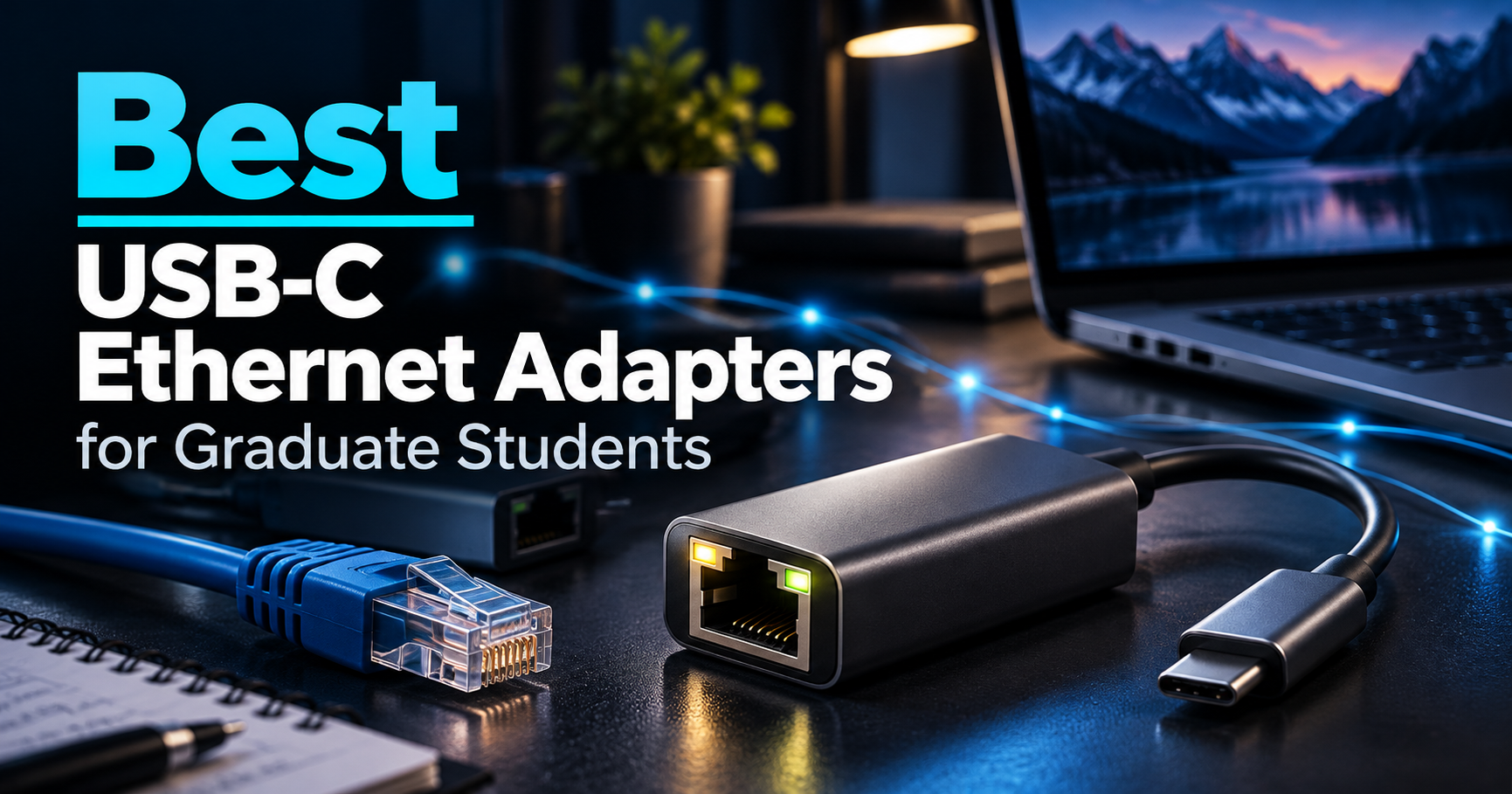
The best USB-C Ethernet adapters for graduate students can make a laptop more useful in research environments where a stable wired network connection matters. Whether you’re transferring experimental datasets to a university server, accessing network-attached storage, or attending an important online research meeting, relying entirely on Wi-Fi is not always ideal.
Many modern laptops no longer include a built-in Ethernet port. A compact USB-C Ethernet adapter solves this problem by allowing you to connect an RJ45 network cable directly to a compatible USB-C port.
However, not every adapter offers the same capabilities. Some provide affordable Gigabit Ethernet, while others support faster 2.5Gbps connections, USB-A compatibility, or USB-C pass-through charging.
In this guide, we’ve selected five USB-C Ethernet adapters for graduate students, comparing speed, compatibility, portability, and features that are particularly useful for laboratory work, research data transfers, and everyday academic productivity.
As an Amazon Associate, GradToolLab earns from qualifying purchases at no additional cost to you.
Editorial Note: Our recommendations are based on manufacturer specifications, publicly available product information, Amazon customer feedback, and practical use cases for graduate students and researchers. We have not independently tested these Ethernet adapters. Advertised network speeds represent maximum supported link rates, not guaranteed internet or file-transfer performance. Actual results depend on your computer, network infrastructure, cables, drivers, and internet connection. Prices, availability, and customer ratings may change.
1. UGREEN USB-C 2.5Gbps Ethernet Adapter
BEST OVERALL
Best for: Graduate students who want a versatile 2.5Gbps Ethernet adapter for compatible high-speed research networks, NAS connections, and everyday laptop use.
Pros
- Supports Ethernet link speeds up to 2.5Gbps
- Compatible with 1Gbps and slower Ethernet networks
- Compact aluminum housing
- Short integrated USB-C cable
- Useful for laptops without built-in Ethernet
- Strong balance of performance, price, and everyday practicality
Cons
- Supports Ethernet link speeds up to 2.5Gbps
- Compatible with 1Gbps and slower Ethernet networks
- Compact aluminum housing
- Short integrated USB-C cable
- Useful for laptops without built-in Ethernet
- Strong balance of performance, price, and everyday practicality
The UGREEN USB-C 2.5Gbps Ethernet Adapter earns our Best Overall recommendation because it combines a relatively affordable price with support for faster wired networking.
For graduate students, an Ethernet adapter is often purchased to solve a simple problem: connecting a laptop to a network that is more reliable or better suited to the task than the available Wi-Fi.
However, research environments sometimes involve more demanding requirements.
For example, a student working with large simulation datasets may need to transfer results from a laboratory computer to network-attached storage. Another researcher might frequently access shared files on a departmental server.
In these situations, network performance can affect how efficiently data is moved between systems.
This UGREEN adapter supports Ethernet connections up to 2.5Gbps, giving it more potential bandwidth than conventional 1Gbps adapters when connected to compatible infrastructure.
The additional bandwidth may be useful when transferring large files between a laptop and a 2.5GbE-capable NAS, workstation, or network switch.
It also offers backwards compatibility with slower Ethernet connections, making it practical for environments that have not upgraded beyond Gigabit Ethernet.
That flexibility is one reason we selected it as the overall recommendation.
Students can use the adapter with an ordinary 1Gbps network today while retaining the ability to connect to faster equipment in the future.
The compact aluminum design is another advantage.
Graduate students often move between home, research laboratories, offices, and conference venues. Carrying a large docking station solely to obtain an Ethernet connection can be inconvenient.
A compact adapter provides a more portable solution.
The short integrated USB-C cable also allows the adapter to rest beside the laptop instead of placing a larger housing directly against the computer’s port.
The main limitation is that 2.5Gbps capability does not guarantee 2.5Gbps performance.
If the connected network switch, router, or storage device supports only 1Gbps, the Ethernet connection will operate at a mutually supported lower speed.
Similarly, a fast local network does not automatically increase internet download speeds when the internet connection itself is slower.
This adapter is especially suitable for graduate students using modern USB-C laptops in research environments.
It is a strong choice for students who regularly transfer large files to network-attached storage, access departmental servers, or connect to wired laboratory networks.
Researchers working with large image collections, simulation results, video recordings, or shared project files may appreciate the option of 2.5Gbps connectivity.
It is also suitable for students who want a single Ethernet adapter that remains useful when they move from a conventional Gigabit network to faster infrastructure.
However, if your university or home network is limited to 1Gbps and you do not expect to upgrade, the less expensive UGREEN Gigabit model may provide better value.
Students who need to charge their laptop through the same USB-C port should consider the Plugable USBC-E2500PD instead.
- Brand: UGREEN
- Product: USB-C to 2.5G Ethernet Adapter
- Host connection: USB-C
- Network connector: RJ45 Ethernet
- Maximum advertised link speed: 2.5Gbps
- Backward compatibility: 1Gbps and slower supported Ethernet connections
- Housing: Aluminum
- Cable: Short integrated USB-C cable
- Pass-through charging: Not provided
- Primary applications: Research networks, NAS transfers, wired laptop connections, and high-speed local networking
The advertised 2.5Gbps speed is the maximum supported Ethernet link rate, not a guarantee of sustained data throughput.
Achieving a 2.5Gbps link requires compatible equipment at both ends of the connection, together with suitable cabling.
Cat5e or better cabling is commonly suitable for 2.5GBASE-T when installed and operated within the applicable specifications.
For the best results, use a computer with an appropriate USB 3.x-capable USB-C port and a network switch or router supporting 2.5GbE.
Operating-system support and driver requirements should be checked against the manufacturer’s current compatibility documentation, particularly when using managed university computers.
2. UGREEN USB-C Gigabit Ethernet Adapter
BEST BUDGET
Best for: Graduate students who need an affordable, straightforward wired Ethernet connection for university networks, online meetings, and everyday laptop use.
Pros
- Affordable compared with many 2.5Gbps adapters
- Supports up to 1Gbps Ethernet
- Compact and portable design
- USB-C connection for compatible laptops
- Suitable for ordinary wired university and home networks
- No need to pay for higher speeds when infrastructure is limited to 1Gbps
Cons
- Limited to Gigabit Ethernet rather than 2.5Gbps
- Does not support USB-C pass-through charging
- Only provides a network connection, not additional USB ports
- Requires compatible USB-C hardware and operating-system support
- Actual internet performance depends on the upstream connection
The UGREEN USB-C Gigabit Ethernet Adapter is our Best Budget recommendation because it provides the essential functionality most students need without the additional cost of multi-gigabit networking.
Although 2.5Gbps adapters are becoming more accessible, a conventional 1Gbps wired connection remains useful for many everyday computing tasks.
For example, graduate students frequently use their laptops for online research meetings, accessing university resources, downloading papers, submitting assignments, and connecting to remote systems.
A wired connection can help avoid some of the uncertainty associated with a congested or weak Wi-Fi signal.
In a shared office or university laboratory, wireless network quality may vary depending on building construction, nearby devices, access-point congestion, and the number of connected users.
Connecting through Ethernet can provide a more consistent local link when an appropriate wired network is available.
The UGREEN Gigabit adapter offers this functionality in a compact USB-C accessory.
We particularly like its simplicity.
The adapter does not attempt to replace a full docking station. Instead, it focuses on adding a single RJ45 Ethernet port to a compatible laptop.
That makes it easy to carry in a backpack and convenient to keep at a research desk.
Its affordability is another important advantage.
Graduate students often purchase several accessories for their laptops, including charging cables, external storage, adapters, and office equipment.
Spending more on a 2.5Gbps adapter is not necessary if the network you use supports only 1Gbps.
For ordinary file downloads, cloud-based writing, video meetings, and many remote-access tasks, Gigabit Ethernet is already a capable connection.
The main tradeoff is the absence of faster multi-gigabit networking.
Students frequently moving large datasets across a compatible 2.5GbE local network may benefit from upgrading to the faster UGREEN model.
This adapter is ideal for students who want an inexpensive way to connect a USB-C laptop to a wired network.
It is particularly suitable for graduate students working in libraries, research offices, and laboratories with existing Gigabit Ethernet infrastructure.
Students who frequently participate in online meetings or access remote university systems may also appreciate a wired connection.
It can be useful as a small backup accessory when Wi-Fi is unavailable or unreliable.
However, students working with high-speed NAS systems or other multi-gigabit equipment should consider a 2.5Gbps model.
Likewise, students who need extra USB ports, display output, and charging in addition to Ethernet may be better served by a USB-C hub or docking station.
- Brand: UGREEN
- Product: USB-C to Gigabit Ethernet Adapter
- Host connection: USB-C
- Network connector: RJ45 Ethernet
- Supported Ethernet rates: 10/100/1000Mbps
- Maximum advertised link speed: 1Gbps
- Selected cable variation: Approximately 0.3 ft
- Housing: Aluminum
- Pass-through charging: No
- Primary applications: Everyday wired networking, university connections, online meetings, and remote work
A 1Gbps network connection has a theoretical maximum signaling rate of 1,000 megabits per second.
Actual application throughput is lower because of protocol overhead and other limitations.
The adapter cannot increase the speed of a slower internet service or network connection.
Before purchasing, confirm that your computer supports compatible USB-C Ethernet adapters and that your university permits connecting personal networking accessories.
Some institutional systems may require network registration or authentication before access is granted.
3. Anker USB-C to Ethernet Adapter 1Gbps
BEST GIGABIT ALTERNATIVE
Best for: Graduate students who prefer an Anker Ethernet adapter for straightforward Gigabit networking and portable everyday use.
Pros
- Supports up to 1Gbps wired Ethernet
- Compact aluminum adapter body
- Short braided USB-C cable
- Suitable for compatible Windows laptops, MacBooks, and Chromebooks
- Strong customer feedback on the selected Amazon listing
- Convenient for home, laboratory, and university office use
Cons
- Does not support 2.5Gbps Ethernet
- More expensive than the selected UGREEN Gigabit model
- No Power Delivery pass-through charging
- Does not add other USB or display connections
- Actual compatibility depends on the host device and operating system
The Anker USB-C to Ethernet Adapter is our Best Gigabit Alternative because it provides a straightforward wired networking solution from a widely recognized computer accessories brand.
Although it does not offer the higher maximum link speed of a 2.5Gbps adapter, it can still handle many tasks graduate students perform every day.
These include joining online seminars, accessing university resources, connecting to remote computers, and transferring files over ordinary Gigabit networks.
Anker advertises support for 10/100/1000Mbps Ethernet connections, allowing the adapter to negotiate a compatible link speed with supported network equipment.
Its aluminum body and braided cable give it a distinctive physical design compared with some basic plastic alternatives.
For graduate students who regularly carry accessories between home and campus, a compact Ethernet adapter is easier to manage than a full-size docking station.
The short cable is also practical when the laptop is positioned on a stand or when an Ethernet cable is connected near other accessories.
Another reason we included this model is the strong customer feedback shown on its Amazon listing.
At the time of our comparison, the selected product had a particularly high average rating and substantial purchase activity.
However, customer ratings do not establish measured reliability or guarantee compatibility with every computer.
The main reason to choose this Anker model over the less expensive UGREEN Gigabit adapter is personal preference for its design, brand, and product support rather than additional network speed.
Both serve a similar purpose.
For students who only need reliable basic Ethernet connectivity, either can be a reasonable choice.
This model is particularly suitable for graduate students who already use Anker laptop accessories and prefer keeping their setup within a familiar product ecosystem.
It is also useful for students who need a portable Gigabit Ethernet adapter for working in research laboratories, offices, and conference locations with accessible wired networks.
Students connecting to a conventional 1Gbps network will not gain a faster Ethernet link simply by purchasing a more expensive 2.5Gbps adapter.
For those users, this Anker model may provide all the networking functionality they need.
However, anyone planning to transfer very large research datasets over a 2.5GbE-capable network should consider the UGREEN 2.5Gbps or Plugable alternatives.
- Brand: Anker
- Product: USB-C to Ethernet Adapter
- Host connection: USB-C
- Network connector: RJ45
- Supported Ethernet rates: 10/100/1000Mbps
- Maximum advertised link speed: 1Gbps
- Design: Aluminum housing with short braided cable
- Power: USB bus-powered
- Pass-through charging: Not provided
- Primary applications: Gigabit networking, video meetings, laboratory computers, and portable laptop connectivity
The maximum Gigabit link speed requires a compatible Ethernet network and appropriate host support.
The USB-C connector is intended for data communication. It should not be confused with a charging port.
This adapter does not provide USB-C Power Delivery pass-through.
Operating-system and device support should be checked against the specific Anker product listing before purchasing, especially for institutionally managed computers or devices with restricted driver installation.
4. Plugable USBC-E2500
BEST DUAL-CONNECTOR
Best for: Graduate students who use both modern USB-C laptops and older USB-A laboratory computers and want a single adapter capable of 2.5Gbps networking.
Pros
- Supports up to 2.5Gbps Ethernet
- Dual USB-C and USB-A connection design
- Useful across different generations of computers
- Compatible with supported Windows, macOS, and ChromeOS systems
- Supports standard Gigabit and slower Ethernet connections
- Useful for research networks and NAS access
Cons
- Full 2.5Gbps performance requires a suitable USB connection and network
- USB 2.0 connections cannot provide full 2.5Gbps performance
- No pass-through laptop charging
- Some operating systems may require drivers or updates
- No additional USB, HDMI, or card-reader ports
The Plugable USBC-E2500 earns our Best Dual-Connector recommendation because it addresses a particularly common challenge in research environments: working with computers from different hardware generations.
Graduate students may own a modern laptop with USB-C ports while their laboratory continues to use older desktop computers equipped primarily with USB-A.
Depending on the research group, these computers may be used for instrument control, scientific programming, data analysis, or other specialized tasks.
Maintaining separate Ethernet adapters for each computer can be inconvenient.
The USBC-E2500 combines a USB-C connector with a USB-A conversion attachment, allowing the same adapter to connect to different compatible computers.
This flexibility makes it one of the most practical products in our comparison for students who frequently move between personal and laboratory systems.
It also supports Ethernet link speeds up to 2.5Gbps.
When connected to compatible multi-gigabit infrastructure, this provides greater potential network bandwidth than a traditional 1Gbps adapter.
For example, a student transferring large experiment files between a laptop and a network-attached storage system may benefit from a 2.5GbE connection if both devices and the intervening network support the higher speed.
Plugable also identifies support for features such as Wake-on-LAN, Energy-Efficient Ethernet, and jumbo frames, although availability and configuration can differ between operating systems.
These features may be relevant in certain network environments, but most students will not need to configure them manually.
One important limitation is that full 2.5Gbps performance requires a sufficiently fast USB host interface.
Plugable recommends a compatible USB 3.0 connection when using USB-A.
Connecting through an older USB 2.0 port may still allow network access, but available throughput will be substantially reduced.
The USBC-E2500 is therefore most attractive to students who genuinely need its dual-connector flexibility rather than users who always connect to the same USB-C laptop.
This adapter is ideal for graduate students who use multiple computers with different USB connectors.
It is especially useful for researchers moving between a personal USB-C laptop and an older laboratory workstation.
Students performing data analysis on shared desktop computers may appreciate having one adapter that supports both connection types.
It can also be a useful travel accessory for researchers who cannot predict which type of computer will be available at a temporary workspace.
However, students using exclusively USB-C devices may find the UGREEN 2.5Gbps adapter simpler.
Those who need charging through the same USB-C connection should consider the Plugable USBC-E2500PD instead.
- Brand: Plugable
- Model: USBC-E2500
- Host connection: USB-C with USB-A adapter
- Recommended host interface: USB 3.0 / 5Gbps or suitable USB-C connection
- Network connector: RJ45
- Supported Ethernet rates: 10/100/1000/2500Mbps
- Maximum advertised link speed: 2.5Gbps
- Ethernet chipset: Realtek RTL8156B
- Additional supported features: Wake-on-LAN, Energy-Efficient Ethernet, and jumbo frames subject to operating-system support
- Pass-through charging: No
- Primary applications: Mixed USB-A/USB-C computers, NAS access, and research laboratory networking
The USB-A attachment converts the physical host connection but does not eliminate the limitations of the underlying USB interface.
For maximum performance, use a compatible USB 3.x port and 2.5GbE-capable network equipment.
Plugable states that Windows, macOS, ChromeOS, and certain Linux configurations are supported, with platform-specific driver and feature considerations.
Managed university computers may restrict driver installation, so check with your institution’s IT department where necessary.
The adapter does not bypass university network access controls or authentication requirements.
5. Plugable USBC-E2500PD
BEST FOR CHARGING
Best for: Graduate students who want 2.5Gbps wired Ethernet and compatible USB-C laptop charging through a single computer port.
Pros
- Supports Ethernet link speeds up to 2.5Gbps
- Supports USB-C Power Delivery pass-through charging up to 100W
- Combines networking and charging through one laptop connection
- Useful for laptops with limited USB-C ports
- Compact integrated-cable design
- Compatible with supported USB-C, USB4, and Thunderbolt host connections
Cons
- USB-C charger is not included
- Actual charging power depends on the charger and laptop
- Does not provide additional USB data or display ports
- More expensive than basic Gigabit Ethernet adapters
- No USB-A host connection
- Requires compatible Power Delivery hardware for pass-through charging
The Plugable USBC-E2500PD is our Best for Charging recommendation because it combines two useful laptop functions: wired Ethernet and USB-C Power Delivery.
Many thin-and-light laptops have a limited number of USB-C ports.
For a graduate student using a laptop with only one or two ports, connecting a charger and an Ethernet adapter at the same time may be inconvenient.
The USBC-E2500PD addresses this problem by providing a dedicated USB-C power input alongside its Ethernet connection.
A compatible USB-C charger can be connected to the adapter, allowing power to pass through to the laptop while the Ethernet connection remains active.
Plugable advertises support for up to 100W pass-through charging.
This is particularly useful when working at a research desk for several hours.
For example, a student may need a stable wired connection to access research files while running programming tools, spreadsheets, or other applications.
Instead of choosing between charging the laptop and connecting to Ethernet, the adapter can support both functions through one USB-C computer connection.
Its 2.5Gbps Ethernet capability also means it is not limited to basic Gigabit networking.
When paired with compatible equipment, it can provide additional bandwidth for local data transfers.
Another advantage is portability.
A full docking station can also combine Ethernet and charging, but it may include HDMI outputs, additional USB ports, and other functions that are unnecessary for students who only need networking and power.
The Plugable adapter offers a more focused solution.
However, the advertised 100W charging capacity should be interpreted carefully.
It represents the adapter’s maximum supported pass-through capability, not a guarantee that every laptop will receive 100W.
The connected charger, laptop charging requirements, USB Power Delivery negotiation, and cable capabilities all influence actual power delivery.
Also, the adapter does not include a charger.
Students need to supply their own compatible USB-C charging equipment.
This adapter is particularly suitable for students using laptops with limited USB-C connectivity.
It is a strong option for students who work for long periods in a laboratory or university office and need both reliable network access and laptop charging.
Students who regularly connect to a wired network while working with research datasets may appreciate the simpler desk setup.
It may also be useful for students who travel with a compact USB-C charger and prefer not to carry a full docking station.
However, students who need several additional USB ports, HDMI output, or an SD card reader may be better served by a multiport USB-C hub.
Those who do not need pass-through charging can save money by choosing a conventional Ethernet adapter.
- Brand: Plugable
- Model: USBC-E2500PD
- Host connection: USB-C
- Host data interface: USB 3.0 / 5Gbps
- Network connector: RJ45
- Supported Ethernet rates: 10/100/1000/2500Mbps
- Maximum advertised Ethernet link speed: 2.5Gbps
- Ethernet chipset: Realtek RTL8156B
- Charging: USB-C Power Delivery pass-through, up to 100W
- Power Delivery standard: USB PD 3.0
- Charger included: No
- Primary applications: Wired laptop networking with simultaneous charging
Plugable specifies support for compatible Windows, macOS, and ChromeOS systems, together with selected USB-C mobile devices.
Compatibility depends on the host’s USB and Power Delivery capabilities.
The side USB-C connector is intended for compatible power input, not as a general-purpose USB data expansion port.
For full 2.5Gbps networking, the connected Ethernet equipment must also support 2.5GbE.
The adapter can operate without an external charger for its Ethernet functionality, while pass-through laptop charging requires a suitable USB-C power source.
Before purchasing, verify that your laptop supports charging through its USB-C port and that the chosen charger meets your laptop’s power requirements.
Quick Comparison: Which USB-C Ethernet Adapter Should You Choose?
The five adapters in this guide cover different priorities, from affordable Gigabit Ethernet to faster 2.5Gbps connections and charging support.
| Ethernet Adapter | Best For | Maximum Ethernet Link Speed | Main Advantage |
|---|---|---|---|
| UGREEN USB-C 2.5Gbps | Best Overall | 2.5Gbps | High-speed networking at a reasonable price |
| UGREEN USB-C Gigabit | Best Budget | 1Gbps | Affordable everyday Ethernet |
| Anker USB-C Gigabit | Best Gigabit Alternative | 1Gbps | Compact braided-cable design |
| Plugable USBC-E2500 | Best Dual-Connector | 2.5Gbps | USB-C and USB-A compatibility |
| Plugable USBC-E2500PD | Best for Charging | 2.5Gbps | Up to 100W USB-C PD pass-through |
For most students who want one versatile adapter, the UGREEN USB-C 2.5Gbps is our overall recommendation.
However, a 1Gbps adapter is often sufficient when your network does not support faster Ethernet.
If you use both older and newer computers, the Plugable USBC-E2500 may be a better fit. If laptop charging is important, consider the USBC-E2500PD.
How to Choose the Best USB-C Ethernet Adapters for Graduate Students
1. Understand 1Gbps vs. 2.5Gbps Ethernet
The biggest performance difference between these adapters is the maximum supported Ethernet link speed.
Gigabit Ethernet supports a link rate of up to 1Gbps, while 2.5 Gigabit Ethernet supports up to 2.5Gbps.
This means that, under suitable conditions, a 2.5GbE connection can provide 2.5 times the theoretical bandwidth of a 1GbE connection.
However, the difference is meaningful only when the connected network supports the higher speed.
A 2.5Gbps adapter connected to a 1Gbps switch will not create a 2.5Gbps connection.
The same limitation applies if the destination NAS or another device supports only Gigabit Ethernet.
For graduate students using conventional university networks, a 1Gbps adapter may already provide everything they need.
A 2.5Gbps adapter becomes more attractive when working with compatible high-speed laboratory networks or network-attached storage.
The important distinction is between maximum supported link speed and actual application throughput.
Ethernet link rates describe the connection’s capability, not a guaranteed file-transfer or internet speed.
2. Check Your Computer’s USB Connection
USB-C Ethernet adapters require a suitable USB host connection.
Most modern laptops provide USB-C ports, but these ports do not all have identical capabilities.
Some support USB 2.0 data speeds, while others provide USB 3.x, USB4, or Thunderbolt connectivity.
For a 2.5Gbps Ethernet adapter, a sufficiently fast USB data interface is important.
For example, Plugable specifies USB 3.0 connectivity for full performance with its USBC-E2500.
Using an older USB 2.0 connection can limit the available throughput considerably.
Students should also check physical connector compatibility.
The Plugable USBC-E2500 is useful because it supports both USB-C and USB-A connections.
This may be particularly convenient in research environments where modern personal laptops coexist with older laboratory desktop computers.
If your laptop needs several additional connections beyond Ethernet, a standalone adapter may not be enough.
Our best USB-C hubs for graduate students guide compares accessories with additional USB ports, displays, charging, and other connectivity features.
3. Determine Whether You Need Power Delivery
USB-C Power Delivery allows compatible devices to receive electrical power over a USB-C connection.
Most Ethernet adapters in this guide do not provide pass-through charging.
This means that the USB-C port used by the adapter is occupied for network connectivity.
For laptops with several USB-C ports, this may not be a problem.
However, students using smaller laptops may prefer to charge their computers while maintaining a wired network connection through the same port.
The Plugable USBC-E2500PD is designed for this situation.
It combines a 2.5Gbps Ethernet connection with an additional USB-C Power Delivery input.
With a compatible charger connected, the adapter can support up to 100W of pass-through charging.
Actual power delivery depends on the charger, laptop, and negotiated charging profile.
Students should not assume that the adapter itself generates 100W or includes a charger.
For a suitable external power supply, see our best USB-C chargers for graduate students guide.
4. Check Your Ethernet Cable and Network Equipment
Buying a faster Ethernet adapter is only part of building a faster wired connection.
You also need compatible infrastructure.
For a 2.5GbE connection, check the following:
- The network switch or router supports 2.5Gbps Ethernet.
- The destination computer or NAS supports an appropriate network speed.
- The Ethernet cable is suitable and in good condition.
- The host computer provides adequate USB performance.
- The operating system recognizes the adapter correctly.
Cat5e cabling is generally suitable for 2.5GBASE-T under compliant installation conditions, so upgrading to 2.5GbE does not automatically require replacing every cable with Cat6 or Cat6a.
However, damaged cables, inappropriate wiring, and poor connections can still cause problems.
In university environments, students should not modify shared network equipment without authorization.
If the laboratory’s network infrastructure supports only 1Gbps, the most practical solution may simply be to use a Gigabit adapter.
5. Consider Driver and Operating-System Compatibility
Many USB Ethernet adapters are supported by modern operating systems, but compatibility is not always identical.
Windows, macOS, ChromeOS, and Linux may use different drivers or support different advanced features.
Some adapters work immediately when connected, while others may require a driver, operating-system update, or configuration change.
This is particularly important for graduate students using university-managed computers.
A research laboratory computer may restrict software installation or require administrator approval for new hardware.
Before buying an adapter for a specialized laboratory system, check its operating system and the adapter manufacturer’s compatibility documentation.
Plugable provides platform-specific information for its USBC-E2500 and USBC-E2500PD models.
If you work with a university-maintained workstation, ask the IT administrator whether external USB network adapters are permitted.
6. Think About Portability and Desk Setup
Ethernet adapters vary in size, cable design, and additional functionality.
A compact adapter is useful when you frequently carry your laptop between classrooms, laboratories, and libraries.
Short integrated cables can also help prevent larger adapter bodies from blocking nearby USB ports.
For a permanent workstation, cable management may matter more than the smallest possible accessory.
An Ethernet cable, charger, external monitor, and several other peripherals can quickly create a cluttered desk.
If you regularly connect an external display for programming, research writing, or data analysis, our best monitors for graduate students guide can help you plan a more comfortable workstation.
Choose an Ethernet adapter based on the connections you genuinely need, rather than simply selecting the product with the highest advertised speed.
When Is Wired Ethernet Better Than Wi-Fi for Research?
Wi-Fi is convenient because it allows students to move around without a physical network cable.
For reading papers, browsing research databases, and writing documents, it is often sufficient.
However, wired Ethernet can be useful in several research-related situations.
Large Research Data Transfers
Researchers sometimes need to move large files between their laptops and shared storage.
Examples include microscopy image collections, experimental video recordings, simulation results, and other substantial datasets.
A compatible wired network may provide more consistent throughput than congested Wi-Fi, particularly when moving files to local network storage.
However, transfer performance also depends on the destination server and storage system.
Remote Desktop and Laboratory Computers
Some graduate students connect remotely to laboratory workstations to run specialized programs or monitor calculations.
A wired network can reduce the variability introduced by wireless signal conditions.
This may improve the consistency of remote desktop sessions, although the total connection quality still depends on both endpoints and the intervening network.
Online Research Meetings
An unstable Wi-Fi connection can interrupt important meetings with supervisors, collaborators, or conference organizers.
Ethernet may help avoid problems caused by poor wireless reception or crowded Wi-Fi channels.
However, a wired connection cannot resolve outages or congestion elsewhere on the network.
Working in Shared University Offices
Research offices may have many wireless devices operating simultaneously.
When approved Ethernet connections are available, using a wired connection can reduce reliance on the local Wi-Fi environment.
Students should follow institutional network policies rather than assuming every available Ethernet outlet is open for personal use.
Do Graduate Students Really Need 2.5Gbps Ethernet?
Not everyone needs a 2.5Gbps adapter.
For ordinary internet browsing, academic writing, email, and many online meetings, a 1Gbps connection is already more than sufficient.
The higher-speed option becomes more valuable when transferring substantial amounts of data over a compatible local network.
Consider a simplified example involving a 20GB file.
At an ideal sustained application transfer rate of 100MB/s, the transfer would take approximately 200 seconds.
At 250MB/s, the same transfer would take approximately 80 seconds.
These figures are illustrative calculations, not measured performance results from any adapter in this guide.
Actual transfer speeds will vary because of Ethernet and file-sharing overhead, network congestion, storage performance, and other limitations.
The example illustrates why multi-gigabit networking can matter when transferring large research datasets frequently.
However, if your network is limited to 1Gbps, a 2.5Gbps adapter will not provide these potential benefits.
For researchers who need portable storage rather than a network connection, a suitable external SSD may be more relevant than upgrading an Ethernet adapter.
USB-C Ethernet Adapter vs. USB-C Hub vs. Docking Station
Before purchasing a standalone Ethernet adapter, consider whether a larger connectivity accessory would better suit your workstation.
Standalone Ethernet Adapter
A dedicated Ethernet adapter is best when you primarily need one additional network connection.
It is usually compact, easy to transport, and relatively affordable.
For students who already have enough laptop ports, this can be the simplest solution.
USB-C Hub
A USB-C hub may combine Ethernet with USB data ports, HDMI output, card readers, and Power Delivery.
This is useful when you need several connections at once.
However, not every USB-C hub includes Ethernet, and the maximum Ethernet speed varies between models.
Some hubs offer only 1Gbps networking even when their USB data ports support much higher transfer rates.
Docking Station
A docking station is generally more appropriate for a permanent desk setup.
It may support several monitors, charging, storage, keyboards, and Ethernet connections through one cable.
For students working primarily from a fixed research office or home workstation, a docking station can simplify everyday connections.
However, it is usually less portable and more expensive than a dedicated Ethernet adapter.
The best option depends on whether Ethernet is your only missing connection or one part of a larger workstation setup.
University Network Security and Compatibility
University networks are often managed differently from ordinary home networks.
Connecting an Ethernet cable does not always provide immediate internet or server access.
Some institutions require device registration, user authentication, network configuration, or approval before a computer can connect.
Device Registration and MAC Addresses
Each Ethernet network interface has a MAC address.
If your institution requires network device registration, the address associated with your USB Ethernet adapter may need to be registered separately from your laptop’s built-in Wi-Fi interface.
Consult your university’s IT documentation before connecting.
IEEE 802.1X Authentication
Some managed networks use IEEE 802.1X for port-based network access control.
In these environments, the computer may need approved credentials or certificates to authenticate over Ethernet.
An adapter that physically connects to the network does not automatically bypass this requirement.
Laboratory Network Restrictions
Research instruments may use isolated or specially configured networks for security and operational reasons.
Do not connect personal devices to instrument-control networks or modify their network settings without authorization.
An unauthorized connection could disrupt equipment communication or violate institutional security policies.
VPN and Remote Access
Certain university resources require a VPN even when the computer is connected through Ethernet.
Using a wired network does not automatically replace the need for university-approved remote-access tools.
When handling sensitive research data, follow institutional requirements for encryption, storage, and network access.
Common Mistakes When Buying a USB-C Ethernet Adapter
Assuming 2.5Gbps Means Faster Internet
The adapter supports a maximum local Ethernet link rate.
It cannot make a slower internet subscription or upstream connection operate at 2.5Gbps.
Ignoring the Network Switch
Both ends of a connection must support the negotiated link speed.
A 2.5Gbps adapter connected to a 1Gbps switch will generally negotiate a 1Gbps link.
Confusing USB-C with USB Data Speed
A USB-C connector does not guarantee a USB 3.x interface.
Check the laptop port specifications and the adapter’s host connection requirements.
Overlooking Driver Support
Some adapters require drivers or operating-system updates.
This matters particularly on shared laboratory computers where software installation may be restricted.
Buying a Charging Adapter Without Checking Power Requirements
A product advertising 100W pass-through charging does not guarantee every laptop will receive 100W.
Confirm the charger’s output, cable suitability, and laptop requirements.
Assuming Wired Networks Are Automatically Authorized
Institutional networks may require device registration, authentication, or explicit permission.
Always follow university IT policies.
Frequently Asked Questions
What is the best USB-C Ethernet adapter for graduate students?
The UGREEN USB-C 2.5Gbps Ethernet Adapter is our Best Overall choice because it combines multi-gigabit capability, portability, and practical value.
For students who only need conventional Gigabit Ethernet, the less expensive UGREEN 1Gbps model may be sufficient.
Is 1Gbps Ethernet fast enough for graduate school?
Yes, for many graduate students.
Gigabit Ethernet is suitable for ordinary academic work, online meetings, remote access, and many file-transfer tasks.
A 2.5Gbps adapter becomes more useful when connecting to compatible high-speed local network equipment.
Is 2.5Gbps Ethernet worth the extra cost?
It can be worthwhile if your network, switch, and destination devices support 2.5Gbps.
Students who transfer large datasets to a compatible NAS may benefit more than students who primarily browse the internet or attend video meetings.
Will a USB-C Ethernet adapter improve my Wi-Fi?
An Ethernet adapter does not directly improve Wi-Fi performance.
Instead, it provides an alternative wired connection that can avoid certain wireless-specific problems.
The resulting connection quality depends on the wired network and upstream internet service.
Can I use a USB-C Ethernet adapter with a MacBook?
Many USB-C Ethernet adapters support compatible MacBooks.
However, verify the selected model’s macOS compatibility and driver requirements before purchasing.
Can I use an Ethernet adapter with an older USB-A computer?
Yes, if the adapter supports USB-A connections.
The Plugable USBC-E2500 includes a dual-connector design for suitable USB-C and USB-A hosts.
A sufficiently fast USB interface is required to take full advantage of 2.5Gbps Ethernet.
Does USB-C Ethernet require a driver?
It depends on the adapter, operating system, and driver availability.
Some operating systems include suitable drivers, while others may require installation or updates.
On managed university computers, consult your IT department before installing networking drivers.
Can I charge my laptop while using Ethernet?
Yes, if your laptop has a separate charging connection or you use an adapter supporting compatible Power Delivery pass-through.
The Plugable USBC-E2500PD supports up to 100W pass-through charging with a suitable external USB-C charger.
Does the Plugable USBC-E2500PD include a charger?
No. It provides a USB-C power input for a compatible charger, but the charger must be supplied separately.
Do I need a Cat6 cable for 2.5Gbps Ethernet?
Not necessarily.
2.5GBASE-T is designed to operate over suitable Cat5e cabling under standard conditions.
Cable quality, length, installation, and connected equipment still matter.
Can I connect a USB Ethernet adapter to a university network?
You may be able to, but access depends on the institution’s policies and technical requirements.
Some university networks require device registration, IEEE 802.1X authentication, or other configuration.
Ask your institution’s IT staff if you are unsure.
Is Ethernet more secure than Wi-Fi?
A wired connection avoids some wireless-specific exposure, but it is not inherently a complete security solution.
Both wired and wireless networks require proper authentication, encryption where appropriate, access controls, and responsible handling of research information.
A wired connection does not automatically make a network trusted.
Should I buy an Ethernet adapter or a docking station?
Choose a standalone Ethernet adapter if you only need wired networking.
A docking station may be more appropriate if you also need several external displays, USB peripherals, charging, and other connections.
Final Verdict: Which USB-C Ethernet Adapter Should You Buy?
For most graduate students who want a versatile wired connection, we recommend the UGREEN USB-C 2.5Gbps Ethernet Adapter.
It provides support for faster local networks while remaining practical for ordinary Gigabit Ethernet connections.
If affordability is your main priority, the UGREEN USB-C Gigabit Ethernet Adapter offers the essential features at a lower price.
The Anker USB-C to Ethernet Adapter 1Gbps is a strong alternative for students who prefer its design and brand.
For graduate students who move between modern USB-C laptops and older USB-A laboratory computers, the Plugable USBC-E2500 offers particularly useful connection flexibility.
And if you want wired Ethernet alongside laptop charging through a single USB-C port, the Plugable USBC-E2500PD is the most convenient choice in this comparison.
Ultimately, the best Ethernet adapter is the one that matches your existing network and daily research workflow.
A 2.5Gbps adapter is not automatically better for a network that supports only 1Gbps, just as a charging-enabled adapter is unnecessary if your laptop already has enough ports.
Choose based on actual compatibility, the way you work, and the infrastructure available in your research environment.
For students who also work away from laboratory outlets, our best power banks for graduate students guide covers portable charging options for academic travel and mobile workstations.

