
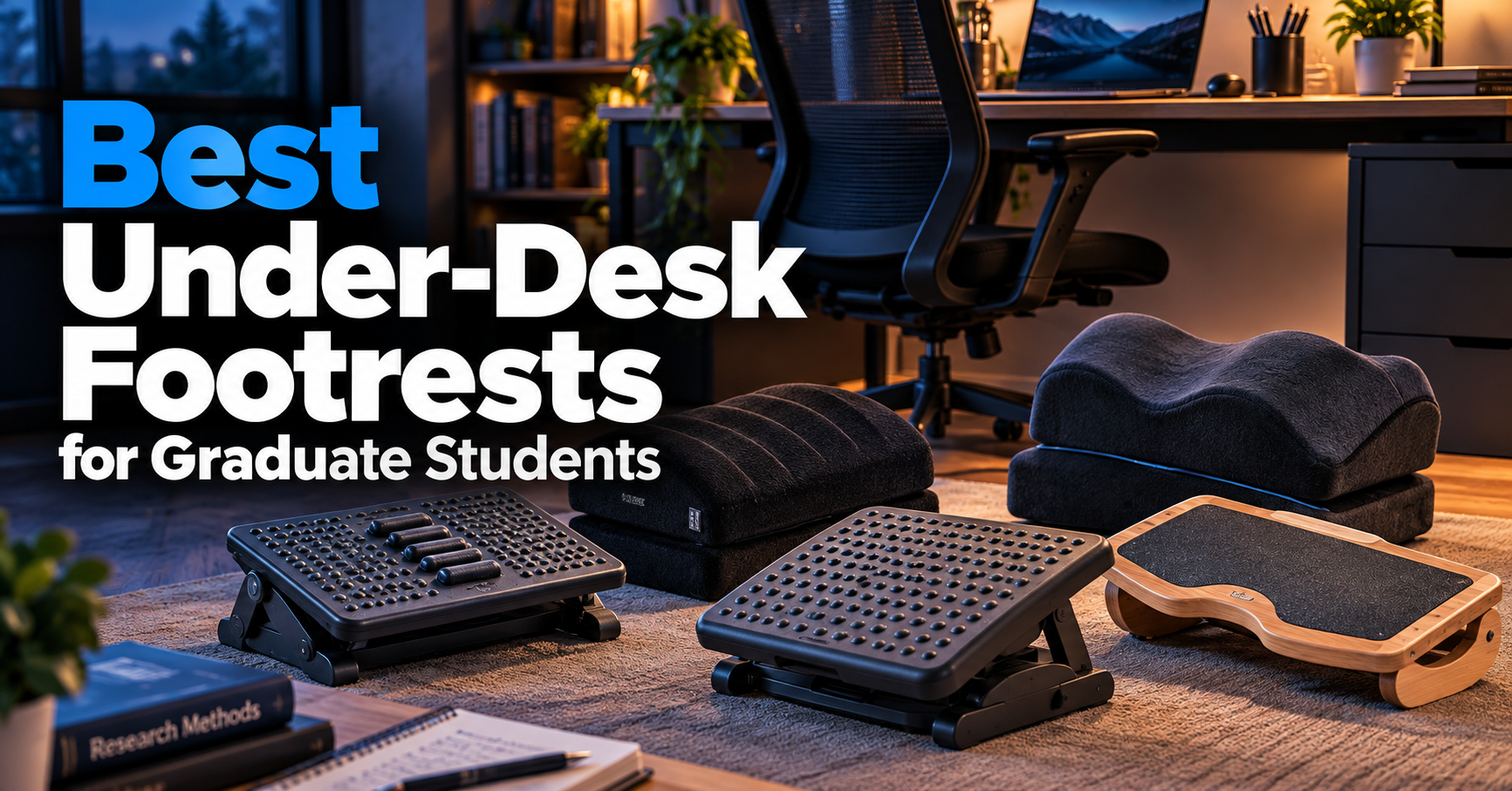
Long hours of writing, coding, and analyzing research data can make a poorly adjusted desk setup uncomfortable—especially when your feet cannot rest comfortably on the floor.
An under-desk footrest can provide additional foot support and help you adjust your seated position without replacing your desk or chair.
In this guide, we compare five of the best under-desk footrests for graduate students in 2026, covering height adjustment, cushioning, rocking designs, stability, and value.
As an Amazon Associate, GradToolLab earns from qualifying purchases at no additional cost to you.
Editorial note: Our recommendations are based on manufacturer specifications, publicly available product information, and practical academic use cases. We have not independently tested these products. Prices, availability, and product specifications may change.
Table of Contents
1. CasaZenith 6-Height Adjustable Footrest
BEST OVERALL
Best for: Graduate students who want an affordable, highly adjustable footrest for different chair heights and desk configurations.
Pros
- Six height settings for flexible positioning
- Firm platform with textured massage rollers
- Non-slip feet for added stability
- Affordable compared with many adjustable alternatives
Cons
- Hard plastic surface offers no cushioning
- Height changes require manual adjustment
- Larger structure than compact foam footrests
The CasaZenith 6-Height Adjustable Footrest is our Best Overall recommendation because it combines a wide height-adjustment range with a relatively affordable design.
For graduate students, one of the biggest challenges of a shared office or university workspace is finding a comfortable relationship between the desk, chair, and floor.
Many desks have fixed heights. If the desk is relatively high, a student may need to raise their chair to keep their shoulders relaxed while typing.
However, raising the chair can leave the feet unsupported.
A footrest can help address this problem by providing a stable surface beneath the feet.
The CasaZenith stands out because it offers six height settings.
According to the product specifications, these positions range from approximately 3.1 to 7.3 inches.
This gives users more flexibility than footrests with only one or two height options.
For example, a student who alternates between a university office and a home study area may need different footrest heights depending on the chair and desk configuration.
The adjustable design allows users to experiment with different positions rather than relying on a single fixed height.
Another advantage is the firm platform.
Unlike foam footrests, the CasaZenith uses a rigid structure that provides a relatively consistent support surface without the compression associated with soft cushioning.
The platform also includes textured areas and foot massage rollers.
These features may provide a different sensation when moving the feet across the surface, although they should not be considered a medical treatment or a substitute for regular movement.
The main disadvantage is that height adjustment requires manually repositioning the support mechanism.
This is less convenient than a footrest that changes height instantly.
Additionally, students who prefer a soft surface may find the hard platform less comfortable than memory foam.
Nevertheless, the combination of six height settings, a structured support platform, and an accessible price makes the CasaZenith a versatile choice for everyday academic work.
The CasaZenith is particularly suitable for graduate students who need to compensate for differences between their desk height, chair height, and natural seated position.
It is worth considering for students who:
- Use desks that cannot be adjusted in height
- Need additional support because their feet do not rest flat on the floor
- Share office furniture with other students
- Prefer firm support rather than cushioning
- Want several height options without purchasing an expensive office accessory
It may be especially useful in university laboratories and shared graduate student offices where replacing furniture is not practical.
For example, a student may find that lowering their chair allows their feet to reach the floor but positions their arms too low for comfortable typing.
Raising the chair and adding an appropriately sized footrest may provide a better overall arrangement.
However, the correct setup depends on the entire workstation.
Students should avoid raising their feet so much that their knees are pushed uncomfortably upward or their thighs lose adequate support.
If your feet already rest comfortably on the floor and your desk and chair are properly adjusted, an additional footrest may not provide a meaningful benefit.
Product type: Height-adjustable rigid footrest
Height settings: Six positions
Height range: Approximately 3.1–7.3 inches
Construction: Plastic support structure
Foot surface: Textured platform with massage rollers
Base: Non-slip contact points
Adjustment mechanism: Manual side adjustments
Power required: No
Best suited for: Standard seated desk arrangements
The six available height positions are the main reason to consider this model.
However, buyers should measure the space beneath their desks before purchasing.
A footrest that is too high may reduce the available space for the legs, especially when combined with a chair that has a thick seat cushion.
Students using compact desks should also check whether the footrest will interfere with chair legs, cables, or other equipment.
For shared workstations, the ability to adjust the height is useful, but the adjustment mechanism may be less convenient if different users need to change the settings frequently.
2. BlissTrends Adjustable Footrest
BEST CUSHIONED
Best for: Graduate students who prefer soft foot support and want an adjustable foam footrest for long study or writing sessions.
Pros
- Soft foam construction
- Two-layer adjustable design
- Removable, machine-washable cover
- Lightweight and easy to reposition
Cons
- Less precise height adjustment than rigid models
- Foam compresses under pressure
- Not ideal for users who prefer a firm platform
The BlissTrends Adjustable Footrest is our Best Cushioned recommendation because it combines a soft resting surface with a simple two-layer height-adjustment system.
While rigid footrests provide structured support, not everyone enjoys placing their feet on a hard plastic platform.
Some students prefer a softer surface, particularly when studying at home without shoes.
The BlissTrends uses a foam construction designed to provide cushioning beneath the feet.
Its curved upper surface offers a different feel from flat, rigid footrests.
One of the product’s most useful features is its two-piece design.
The footrest includes a lower foam section and a larger curved upper section.
The sections can be attached using touch fasteners, allowing users to change the overall height.
According to the product information, the lower section measures approximately 2 inches thick, while the upper section measures approximately 3.7 inches at its stated thickness.
Together, the sections create a taller footrest than either piece alone.
This provides a practical option for students who want cushioning but still need some flexibility in height.
For example, a graduate student using a relatively high chair may prefer the complete two-layer arrangement.
Another student working with a lower chair may find that a reduced height is more comfortable.
However, this adjustment system is fundamentally different from a mechanical footrest.
The BlissTrends does not provide six precisely defined positions like the CasaZenith.
Instead, it allows users to modify the arrangement of the foam sections.
Another advantage is its removable cover.
The manufacturer describes the cover as machine washable, which can be useful for maintaining an item that remains beneath a desk for extended periods.
This is particularly convenient in small apartments, where the same study area may be used for several hours each day.
The main limitation is the foam construction itself.
Foam compresses when weight is applied, so the effective support height may differ from the product’s uncompressed dimensions.
Students who need consistent, rigid foot support may prefer the CasaZenith or HUANUO instead.
Overall, the BlissTrends offers a useful combination of cushioning, simple adjustability, and everyday convenience.
The BlissTrends is a strong option for graduate students who spend substantial time studying or writing at home.
It is particularly suitable for:
- Students who prefer soft contact beneath their feet
- People who usually work in socks
- Graduate students using desks in small apartments
- Students who want a removable, washable cover
- Users who only need a few basic height options
Its cushioning may be appealing during long writing sessions, such as preparing a thesis chapter or reviewing journal articles.
For instance, a graduate student might spend several hours working on a laptop and external monitor.
A soft footrest can provide an alternative resting surface while the student remains seated.
However, softness should not be confused with better ergonomics.
A footrest still needs to support the feet at an appropriate height.
If the foam compresses too much or positions the knees uncomfortably, a different model may be more suitable.
Students who prefer an active rocking motion should consider the StrongTek Wooden Rocking Footrest instead.
Product type: Two-layer cushioned footrest
Material: Foam core with fabric cover
Height adjustment: Two-piece configuration
Lower section: Approximately 16.2 × 9.9 × 2 inches
Upper section: Approximately 3.7 inches thick
Cover: Removable and machine washable
Attachment: Touch fasteners between sections
Surface: Curved cushioned design
Power required: No
Best suited for: Home offices and study desks
The most important consideration is the relationship between foam thickness and actual support height.
Unlike rigid platforms, cushioned footrests compress under the weight of the feet.
Students should therefore evaluate whether the product provides sufficient support in their normal seated position.
The removable cover is an advantage for cleaning, but users should follow the manufacturer’s care instructions and avoid assuming that the foam core itself is machine washable.
Another consideration is desk clearance.
Although foam footrests are generally easy to move, a thick cushion may occupy more vertical space than expected beneath a compact desk.
3. HUANUO Adjustable Footrest
BEST FOR TILT ADJUSTMENT
Best for: Graduate students who want a firm footrest with adjustable height and a tilting platform for changing foot positions.
Pros
- Three adjustable height positions
- Tilting platform for changing foot angles
- Large, textured foot surface
- Firm construction without foam compression
Cons
- Less cushioning than foam alternatives
- Tilting platform does not provide a fixed locked angle
- Bulkier than compact footrest cushions
The HUANUO Adjustable Footrest is our Best for Tilt Adjustment recommendation because it combines height adjustment with a platform designed to move as the user changes foot position.
Some under-desk footrests simply elevate the feet.
Others provide a movable platform that allows the ankles and feet to change position while seated.
The HUANUO belongs to the second category.
Its rigid platform can tilt forward and backward, allowing users to reposition their feet without moving the entire footrest.
This may appeal to students who prefer changing foot angles during extended periods of desk work.
For example, a graduate student analyzing data may remain seated while alternating between typing, reviewing graphs, and reading technical documentation.
During these activities, a tilting footrest allows small adjustments to foot position.
However, this movement should not be confused with exercise or a guaranteed improvement in circulation.
The value of the design is its additional positioning flexibility.
Another important feature is the adjustable height.
The HUANUO provides three height settings, allowing students to choose a position that better matches their desk and chair.
Although this offers fewer options than the CasaZenith, it provides more flexibility than a fixed-height platform.
The foot surface also includes raised textured areas.
These may provide additional grip and a different tactile feel compared with a smooth platform.
However, some users may find a textured plastic surface less comfortable when barefoot.
The main disadvantage is that the tilting platform is designed to move rather than lock firmly at a selected angle.
Students who want their feet to remain in a fixed position should consider whether this behavior suits their preferences.
Another consideration is size.
The HUANUO has a larger structure than a typical foam cushion, which may be inconvenient beneath small desks.
Nevertheless, its combination of firm support, three height settings, and dynamic tilting makes it an attractive option for students who want more adjustability than a basic footrest.
The HUANUO is particularly suitable for graduate students who prefer firm support and frequently change their seated position.
Potential users include:
- Students working with fixed-height desks
- Researchers spending long periods on data analysis
- Graduate students who prefer a tilting platform
- People who dislike foam compression
- Users who want height adjustment and foot-angle flexibility
The tilting design may be especially appealing to users who find fixed footrests restrictive.
However, a moving platform is not automatically more comfortable.
Some students prefer their feet to remain completely stable while typing or reading.
For those users, a non-moving cushioned footrest may be more appropriate.
The HUANUO is also worth considering for shared offices where users need adjustable support but do not necessarily require the six height positions of the CasaZenith.
Product type: Height-adjustable tilting footrest
Height adjustment: Three positions
Tilt: Approximately 0–30 degrees, according to the manufacturer’s product description
Foot surface: Textured rigid platform
Platform width: Approximately 17.1 inches
Base: Freestanding support structure
Adjustment type: Manual height selection and moving tilt platform
Power required: No
Best suited for: Seated computer work
Unlike a fixed-angle footrest, the HUANUO allows the platform to tilt as pressure is applied with the feet.
Students should understand this distinction before purchasing.
The platform is intended to move during use rather than remain locked in every possible position.
For desks with limited clearance, users should also consider how the platform’s movement changes the available space beneath the desk.
The raised position of the platform can bring the knees closer to the underside of the work surface.
Students should confirm that they have enough room to move their legs comfortably.
Another practical consideration is floor compatibility.
A footrest may behave differently on carpet compared with hard flooring, particularly when the user repeatedly changes the platform angle.
4. Everlasting Comfort Memory Foam Footrest
BEST MEMORY FOAM ROCKER
Best for: Graduate students who want a soft memory foam footrest that can also be reversed for gentle rocking movement.
Pros
- Memory foam cushioning
- Reversible design for rocking
- Removable, washable cover
- No mechanical adjustment required
Cons
- No independent height-adjustment mechanism
- Foam compression affects effective support height
- Not suitable for users who require rigid support
The Everlasting Comfort Memory Foam Footrest earns our Best Memory Foam Rocker recommendation because it offers two different ways to support the feet using a simple cushioned design.
Most traditional footrests are built around either a stationary platform or a mechanical rocking mechanism.
The Everlasting Comfort takes a different approach.
It uses a curved memory foam shape that can serve as a stationary footrest in one orientation.
When reversed, the curved surface can also function as a simple rocker.
This makes it an interesting option for students who want the flexibility to change how they position their feet without purchasing a mechanically adjustable footrest.
The product uses memory foam designed to respond to pressure.
For graduate students who prefer cushioning rather than a hard platform, this may provide a more comfortable surface.
For example, a student working on a thesis at home may prefer a soft footrest when sitting without shoes.
The memory foam construction offers a different experience from rigid plastic or wood.
Another advantage is the absence of mechanical components.
There are no height-adjustment screws or complicated moving parts required to switch between the two basic orientations.
To use the rocking configuration, the user simply turns the footrest over.
However, this design has limitations.
The footrest does not provide precise height adjustments.
Additionally, the foam compresses under pressure, meaning that the support height changes depending on how the user’s feet are positioned.
This makes it less suitable for students who need a particular amount of foot elevation to accommodate a fixed desk and chair.
The washable cover is another practical feature.
Because the footrest sits on the floor, a removable cover can make routine cleaning easier.
Overall, the Everlasting Comfort is a good option for students who value cushioning and want a simple way to alternate between stationary support and rocking movement.
The Everlasting Comfort is particularly suitable for graduate students who prefer soft desk accessories.
It may appeal to students who:
- Work at home without shoes
- Prefer memory foam over hard surfaces
- Want a simple reversible rocking option
- Do not need precise height adjustments
- Value easy cleaning and minimal setup
The reversible design can be useful for students who enjoy changing their foot position occasionally.
For example, a student might use the stationary orientation while typing and switch to the rocking orientation during reading sessions.
However, the memory foam construction makes it less suitable for applications requiring a stable, non-compressing surface.
Students who need firm elevation to support their feet at a specific height should consider the CasaZenith or HUANUO instead.
Product type: Reversible memory foam footrest
Material: Memory foam
Dimensions: Approximately 17 × 10 × 5 inches
Height adjustment: No mechanical adjustment
Rocking function: Reversible curved design
Cover: Removable and machine washable
Base: Non-slip surface
Power required: No
Best suited for: Home offices and personal study areas
The manufacturer’s stated dimensions provide a useful starting point for checking desk compatibility.
However, students should remember that the effective height changes when the foam compresses.
This is particularly important for users who need substantial foot elevation.
The reversible design also behaves differently from mechanical rocking platforms.
Instead of using a hinged or pivoting mechanism, the curved foam surface provides the rocking motion.
Users who prefer a more structured rocking platform may find the StrongTek Wooden Rocking Footrest more appropriate.
5. StrongTek Wooden Rocking Footrest
BEST WOODEN ROCKER
Best for: Graduate students who prefer a firm wooden platform and want a simple rocking motion beneath their desk.
Pros
- Wooden construction with a firm support surface
- Rocking design allows changes in foot position
- Textured anti-slip platform
- No assembly required
Cons
- Higher price than several plastic and foam options
- Hard surface provides no cushioning
- No independent height-adjustment settings
The StrongTek Wooden Rocking Footrest is our Best Wooden Rocker recommendation because it combines a rigid wooden platform with a simple curved rocking design.
Unlike conventional stationary footrests, this model allows users to move the platform forward and backward using their feet.
This can provide additional freedom to change foot position while remaining seated.
For graduate students who spend extended periods working at a desk, the ability to reposition the feet may be a useful feature.
For example, a student preparing a conference presentation may alternate between typing, reviewing slides, and reading notes.
During these activities, a rocking footrest can provide an alternative to keeping the feet completely stationary.
However, users should not assume that a rocking footrest replaces standing, walking, or taking regular breaks.
The StrongTek is designed as a support accessory rather than a substitute for physical movement.
Its construction is another distinguishing feature.
The manufacturer describes the platform as being made from Lauan hardwood plywood.
This creates a different appearance and feel from plastic footrests.
The wooden surface may be particularly appealing to students who prefer natural materials or want a more traditional desk accessory.
The platform also includes a textured anti-slip surface intended to provide traction beneath the feet.
This is useful when changing foot position.
However, the firm texture may not appeal to users who prefer soft cushioning.
Another advantage is its simple design.
The rocking motion comes from the shape of the footrest rather than a complicated mechanical system.
The manufacturer also states that the rocker requires no assembly.
This makes it straightforward to introduce into an existing desk setup.
The primary disadvantage is the lack of precise height adjustment.
Unlike the CasaZenith, the StrongTek does not provide multiple fixed elevation settings.
Students who need a specific height to compensate for an unsuitable desk-chair combination may therefore prefer an adjustable model.
Overall, the StrongTek is a distinctive choice for students who want a firm wooden footrest with a simple rocking function.
The StrongTek is particularly suitable for graduate students who value a firm platform and enjoy changing their foot position.
It may be a good choice for:
- Students who prefer wooden desk accessories
- Researchers who dislike foam compression
- Users who want a rocking rather than fixed platform
- Graduate students with sufficient desk clearance
- People who prefer simple accessories without complicated adjustments
Its design may work well in a permanent home office or personal study area.
For example, a graduate student with a wooden desk and traditional office chair may prefer the appearance of this model over a plastic alternative.
However, its value should be judged primarily by its functionality and compatibility rather than appearance.
Students who need cushioning may prefer the Everlasting Comfort.
Those who need height adjustment should consider the CasaZenith or HUANUO.
Product type: Wooden rocking footrest
Material: Lauan hardwood plywood
Platform dimensions: Approximately 18 × 11 inches
Height: Approximately 4.4 inches, according to the manufacturer
Movement: Forward-and-backward rocking
Foot surface: Textured anti-slip covering
Base: Curved supports with non-slip contact points
Assembly: Not required
Power required: No
Best suited for: Seated desk work
The StrongTek is intended to provide a rocking surface beneath a desk.
Students should consider both the physical dimensions and the additional space needed for the rocking movement.
The product may require more front-to-back clearance than a stationary footrest.
Another consideration is the difference between a rocking platform and a height-adjustable footrest.
The StrongTek allows changes in foot angle, but it does not provide multiple independently selectable height positions.
Students who need significant foot elevation should confirm that its dimensions meet their requirements.
Although the manufacturer advertises a substantial structural load capacity, buyers should not assume that every under-desk footrest is intended to be used as a standing platform or step stool.
Follow the instructions for the specific model.
How to Choose an Under-Desk Footrest
Choosing an under-desk footrest requires more than selecting the softest or most adjustable product.
For graduate students, the best choice depends on desk height, chair positioning, available legroom, and personal preferences.
A footrest that works well in one study environment may be uncomfortable in another.
Before purchasing, consider the following factors.
1. Determine Whether You Actually Need a Footrest
The first question is whether your feet already rest comfortably on the floor.
According to the Occupational Safety and Health Administration (OSHA), a well-arranged computer workstation should allow the feet to be supported by the floor or an appropriate footrest.
If a desk cannot be adjusted and the chair must be raised, a footrest may provide useful support.
However, a footrest is not automatically necessary.
If your chair is correctly adjusted and both feet already rest comfortably on the floor, adding a footrest may provide little practical benefit.
Before buying another accessory, evaluate your entire workstation.
Start by adjusting the chair so that your arms and shoulders can remain in a comfortable position while using the keyboard.
Then check whether your feet are supported.
If raising the chair creates a gap between your feet and the floor, a footrest may help.
For additional guidance on selecting and adjusting office seating, explore our guide to the best ergonomic chairs for graduate students.
2. Choose Between Firm and Cushioned Support
Under-desk footrests generally fall into two broad categories: rigid platforms and cushioned designs.
Rigid footrests are commonly made from plastic, wood, or similar materials.
They provide a structured surface that does not compress significantly beneath the feet.
This can be useful when consistent elevation is important.
The CasaZenith and HUANUO are examples of rigid adjustable footrests.
The StrongTek uses a wooden platform with a rocking design.
Cushioned footrests, on the other hand, use foam or memory foam.
These products provide a softer resting surface.
The BlissTrends and Everlasting Comfort are examples of this approach.
Neither design is automatically better.
The right choice depends on whether you need firm support or prefer cushioning.
Students who regularly work in socks may prefer a soft surface, while those who need reliable elevation may benefit from a rigid platform.
3. Pay Attention to Height Adjustment
Height is one of the most important features of a footrest.
A product that is too low may not provide enough support.
A product that is too high may push the knees upward and create an uncomfortable seated position.
Adjustable footrests offer more flexibility.
For example, the CasaZenith provides six height positions.
The HUANUO provides three height settings.
These options may be useful when the user needs to compensate for a fixed-height desk.
Foam footrests can also provide some adjustment through removable layers, as demonstrated by the BlissTrends.
However, foam compression makes their effective height less predictable.
Before purchasing, measure the approximate distance between your feet and the floor when your chair is correctly positioned for typing.
This can help you estimate the amount of elevation required.
Remember that changing the footrest height may also affect knee position and available desk clearance.
4. Understand the Difference Between Tilting and Rocking
Some footrests provide a stationary surface, while others allow movement.
A tilting footrest changes the angle of the platform.
The HUANUO is an example of a model with a moving tilt surface.
A rocking footrest allows the platform to move forward and backward.
The StrongTek Wooden Rocking Footrest uses this type of design.
The Everlasting Comfort can also be reversed to provide a simpler foam-based rocking motion.
These features may appeal to students who prefer to change their foot position occasionally.
However, rocking and tilting are not essential for everyone.
Some users prefer a stable platform that remains in a fixed position.
Others may find that movement makes the footrest more enjoyable to use.
The most appropriate design depends on personal preference and the available space beneath the desk.
5. Measure the Available Space Under Your Desk
Under-desk clearance is easy to overlook.
A large footrest may interfere with chair legs, cables, storage boxes, or desk supports.
This can be particularly problematic in small apartments or university workstations with limited legroom.
Before buying a footrest, measure the space available beneath your desk.
Consider the width and depth of the product, as well as its height.
For rocking and tilting models, allow additional space for movement.
Students using compact study areas should also think about whether the footrest can be moved aside when it is not needed.
For broader workspace planning, our Ultimate Graduate Student Desk Setup Guide explains how to organize a productive research environment.
6. Consider Cleaning and Maintenance
A footrest is positioned close to the floor, so it may collect dust and dirt over time.
The material influences how the product should be cleaned.
Plastic footrests can generally be maintained by following the manufacturer’s surface-cleaning instructions.
Foam footrests often use fabric covers.
For example, the BlissTrends and Everlasting Comfort include removable covers that can be washed according to their care instructions.
This is useful for students who frequently work without shoes.
However, the internal foam should not automatically be treated as washable.
Wooden footrests may require different cleaning procedures.
The best option depends partly on how frequently the product will be used and the conditions of the workspace.
7. Consider Your Overall Desk Setup
A footrest should be treated as one component of a complete workstation.
Chair height, desk height, monitor positioning, keyboard placement, and available legroom all contribute to how comfortable a workstation feels.
For example, a student may purchase a footrest because their feet do not reach the floor.
However, the underlying problem may be that the desk is too high, requiring the chair to be raised.
In this situation, an appropriate footrest may help support the feet, but it does not address every aspect of workstation ergonomics.
If the desk itself is the main limitation, an adjustable desk may provide additional flexibility.
Our guide to the best standing desks for graduate students explores options for creating a more adjustable workspace.
For students who primarily use laptops, a properly arranged laptop stand, external keyboard, and monitor can also influence desk comfort.
Our best laptop stands for graduate students guide explores another part of this setup.
The goal is not to purchase as many accessories as possible.
It is to create a workstation that supports comfortable working positions and allows regular changes in posture.
Do Under-Desk Footrests Actually Help?
An under-desk footrest can be useful, but its benefits depend on the user and the workstation.
The strongest practical reason to use a footrest is to provide support when the feet cannot rest comfortably on the floor.
For example, a student may need to raise their chair to work comfortably at a fixed-height desk.
Without a footrest, their feet may hang above the floor.
This can make it more difficult to maintain a comfortable seated position.
OSHA’s computer workstation guidance identifies a stable footrest as an option when the desk and chair cannot be adjusted sufficiently to support the feet.
However, a footrest should not be viewed as a treatment for medical conditions.
Manufacturers sometimes advertise claims involving back pain, circulation, fatigue, or posture improvement.
These claims should be interpreted carefully.
A footrest may help a user achieve a more suitable seated arrangement, but that does not establish that a specific product will prevent pain or improve circulation.
Can a Footrest Improve Sitting Posture?
A footrest may help support a more comfortable seated position when the feet would otherwise be unsupported.
However, good workstation ergonomics involve more than foot position.
The chair should provide appropriate support, the desk should be at a suitable height, and the user should have enough room to move.
A footrest cannot compensate for every problem caused by poorly arranged furniture.
Are Rocking Footrests Better Than Stationary Footrests?
Not necessarily.
Rocking footrests provide an opportunity to change foot and ankle positions while seated.
This may appeal to users who dislike remaining completely still.
However, the movement provided by a rocking footrest should not replace regular standing and walking breaks.
A stationary footrest may be preferable when consistent foot support is the main objective.
Can a Footrest Replace Regular Breaks?
No.
Even a well-adjusted workstation does not eliminate the need to change position.
OSHA recommends changing working positions and taking opportunities to stand, walk, and move during prolonged computer work.
For graduate students, this can mean briefly standing between writing sessions, walking during breaks, or alternating between seated and standing tasks when practical.
An under-desk footrest is best understood as a support accessory rather than a solution to prolonged sitting.
The most useful footrest is one that addresses a specific problem in your workstation without introducing new discomfort.
FAQ
1. Do graduate students need an under-desk footrest?
Not necessarily.
An under-desk footrest is most useful when the feet cannot rest comfortably on the floor while the chair is positioned at an appropriate height.
Students whose feet are already fully supported may not need one.
Before purchasing, check whether your chair, desk, and keyboard are arranged comfortably.
2. What is the best under-desk footrest for graduate students?
Our Best Overall recommendation is the CasaZenith 6-Height Adjustable Footrest because it provides six height settings and a firm support platform at a relatively affordable price.
However, students who prefer cushioning may find the BlissTrends or Everlasting Comfort more suitable.
The best choice depends on individual preferences and workstation dimensions.
3. Are foam or plastic footrests better?
Neither material is universally better.
Foam footrests provide cushioning and may be more comfortable for users who work without shoes.
Plastic footrests generally provide firmer support and may offer mechanical height adjustment.
Students who need a consistent amount of elevation may prefer a rigid platform.
Those who prioritize softness may prefer foam.
4. Can an under-desk footrest help shorter students?
A footrest may be useful for shorter students whose feet cannot reach the floor when their chair is correctly positioned for desk work.
However, height alone does not determine whether a footrest is necessary.
Chair height, desk height, leg length, and seating preferences also matter.
Adjustable footrests may provide additional flexibility when determining the appropriate support height.
5. Is a rocking footrest worth buying?
A rocking footrest may be worthwhile for users who enjoy changing foot positions while seated.
Models such as the StrongTek Wooden Rocking Footrest provide a simple forward-and-backward movement.
However, users who prefer stable support may find a stationary model more comfortable.
Rocking motion should not replace regular standing or walking breaks.
6. Can I use a footrest with a standing desk?
Yes, an under-desk footrest can be useful when a height-adjustable desk is used in its seated position.
However, the appropriate configuration depends on desk height and chair adjustment.
A footrest designed for seated use should not automatically be treated as a standing platform.
Always follow the manufacturer’s instructions for the specific product.
7. How high should an under-desk footrest be?
There is no single ideal height for every user.
The appropriate height depends on the distance between the feet and the floor when the chair is positioned correctly.
A footrest should support the feet without forcing the knees into an uncomfortable position or restricting legroom.
Adjustable products can make it easier to find a suitable height.
8. Do under-desk footrests improve circulation?
Some manufacturers advertise circulation-related benefits, particularly for rocking or tilting designs.
However, these claims should not be treated as guaranteed medical outcomes.
A footrest can provide support and may allow additional foot movement, but it is not a substitute for regular movement or medical care.
If you have persistent swelling, numbness, pain, or circulation concerns, consult a qualified healthcare professional.
Final Verdict: Which Under-Desk Footrest Should Graduate Students Buy?
The best under-desk footrest depends on how much support you need, whether you prefer cushioning, and how your desk and chair are arranged.
For most graduate students who need additional foot support, the CasaZenith 6-Height Adjustable Footrest is our Best Overall recommendation.
Its six height settings provide flexibility for different seated configurations, while its firm platform offers an alternative to foam cushioning.
The BlissTrends Adjustable Footrest is a strong choice for students who prefer a soft surface.
Its two-layer design and washable cover make it particularly appealing for home study environments.
For those who want both height adjustment and a movable platform, the HUANUO Adjustable Footrest provides three height settings and a tilting surface.
Students who prefer memory foam may find the Everlasting Comfort Memory Foam Footrest more suitable.
Its reversible design also allows it to function as a simple rocker.
Finally, the StrongTek Wooden Rocking Footrest is an attractive option for students who want a firm wooden platform with forward-and-backward movement.
Our Recommendations at a Glance
| Your Priority | Our Recommendation |
|---|---|
| Best overall value and adjustability | CasaZenith 6-Height Adjustable |
| Soft cushioning | BlissTrends Adjustable |
| Height and tilt adjustment | HUANUO Adjustable |
| Memory foam with reversible rocking | Everlasting Comfort |
| Wooden construction and rocking | StrongTek Wooden Rocking |
One Final Consideration
Before purchasing an under-desk footrest, check whether your current desk and chair can be adjusted to support your feet comfortably.
A footrest is most useful when it solves a specific problem with your seated position.
If your feet already rest comfortably on the floor, you may not need an additional accessory.
For graduate students who spend long hours writing, programming, or reviewing research, a properly arranged workspace can make everyday tasks more comfortable.
However, no single accessory can replace appropriate workstation adjustments and regular movement.
Choose the footrest that fits your desk, supports your feet at a comfortable height, and matches your preferred sitting style.
The right choice is not necessarily the most expensive or most adjustable model.
It is the one that provides useful support without adding unnecessary complexity to your research environment.