
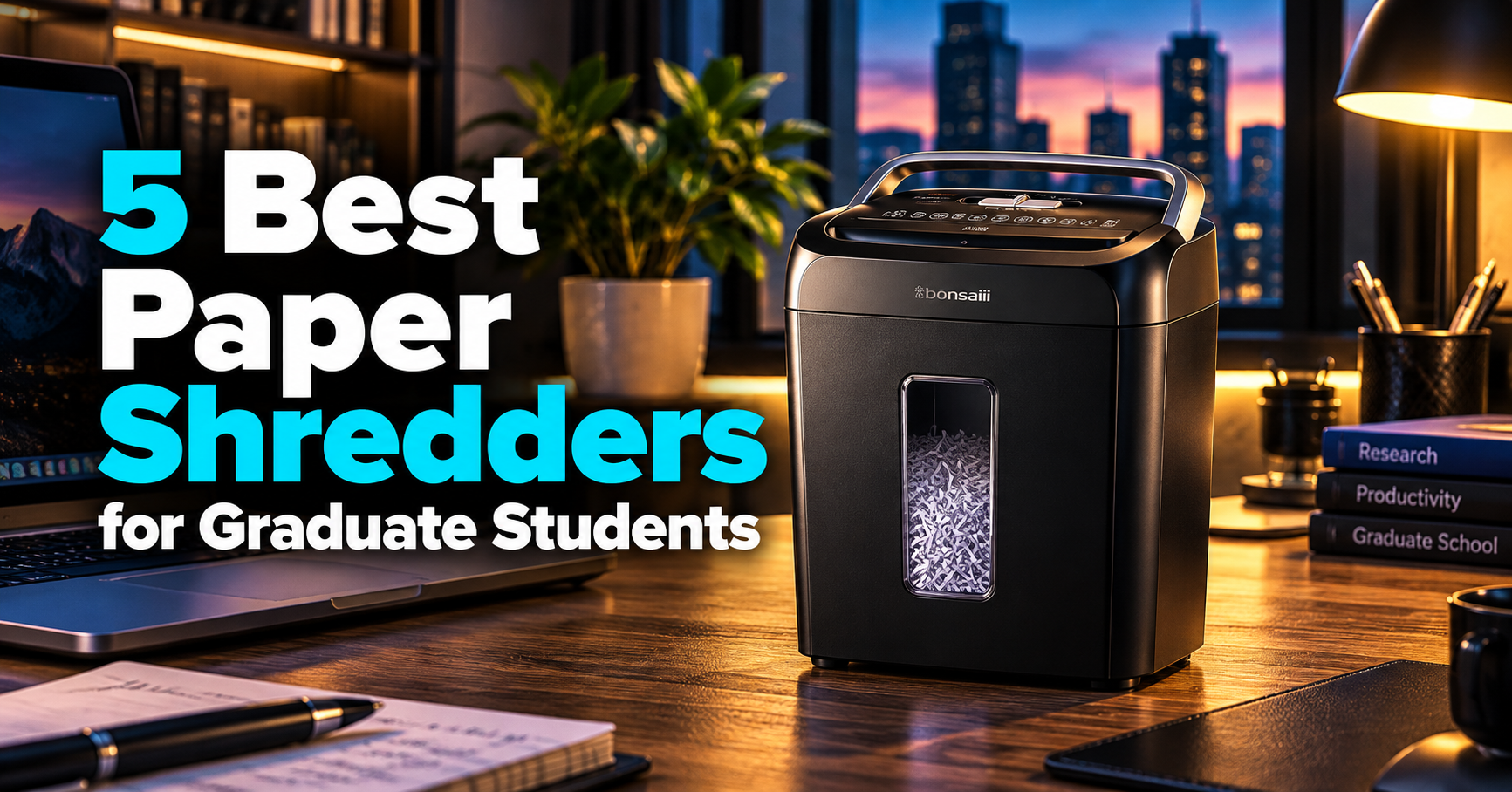
Graduate school involves more paperwork than many students expect.
Between printed research papers, administrative documents, financial statements, teaching materials, and everyday mail, paper can gradually accumulate around a study desk.
Some documents can simply be recycled. Others contain personal information that should not be discarded without proper consideration.
A paper shredder offers a practical way to destroy documents containing names, addresses, account numbers, and other sensitive personal details before disposal.
However, not every graduate student needs an expensive office shredder.
If you only destroy a few documents each week, a compact budget model may be sufficient. Students who regularly clear out folders of paperwork may benefit from a larger shredder with a higher sheet capacity and longer continuous runtime.
The challenge is choosing a shredder that matches your actual needs.
A model advertised as an 18-sheet shredder may sound considerably better than an 8-sheet alternative, but sheet capacity is only one part of the equation.
Security level, continuous runtime, cooling requirements, wastebasket capacity, maintenance, and noise can all influence the experience.
For this guide, we compared five popular paper shredders from Amazon Basics, Bonsaii, and Fellowes.
Our overall recommendation is the Bonsaii C275-A 12-Sheet Cross-Cut Shredder, which provides a useful balance of shredding capacity, price, and everyday convenience.
For students on a tighter budget, the Amazon Basics 8-Sheet Cross-Cut offers a particularly affordable alternative.
Meanwhile, the Fellowes Powershred 99Ci is designed for people who regularly handle considerably larger quantities of paper.
Let’s find the best paper shredder for your home office or graduate-school workspace.
Disclosure: As an Amazon Associate, GradToolLab earns from qualifying purchases at no additional cost to you.
Table of Contents
Quick Comparison: Best Paper Shredders for Graduate Students
| Paper Shredder | Best For | Sheet Capacity | Security Level | Reference Price |
|---|---|---|---|---|
| Bonsaii C275-A | Best Overall | 12 sheets | P-4 | $64.99 |
| Amazon Basics 8-Sheet Cross-Cut | Best Value | 8 sheets | P-4 | $35.59 |
| Bonsaii C237-B | Best Compact | 6 sheets | P-4* | $34.99 |
| Fellowes 14C10 | Best for Home Office | 14 sheets | P-4 | $99.99 |
| Fellowes Powershred 99Ci | Best Heavy-Duty | 18 sheets | P-4 | $299.99 |
Prices are based on Amazon.com listings checked in October 2026, with delivery set to New York 10001. Prices and availability may change.
The Bonsaii C237-B listing reviewed for this guide identifies the product as P-4. Check the security rating of the exact version offered before purchasing, as product documentation and variants may differ.
Our Quick Recommendations
Best Overall: Bonsaii C275-A
A balanced 12-sheet shredder with a 5.5-gallon wastebasket and P-4 cross-cut security. Suitable for students who regularly dispose of personal documents without needing commercial-grade equipment.
Best Value: Amazon Basics 8-Sheet Cross-Cut
An affordable shredder with P-4 security and an 8-sheet capacity. Particularly attractive for occasional home use.
Best Compact: Bonsaii C237-B
A smaller 6-sheet model with a 3.4-gallon wastebasket. Useful for students who want a basic shredder without dedicating much space to it.
Best for Home Office: Fellowes 14C10
A 14-sheet shredder with a convenient pull-out wastebasket, a safety lock, and a longer continuous runtime than the budget models.
Best Heavy-Duty: Fellowes Powershred 99Ci
An 18-sheet shredder with a 30-minute maximum runtime, jam-prevention technology, and a large 9-gallon wastebasket.
Which Paper Shredder Should You Choose?
For most graduate students who regularly dispose of personal documents, the Bonsaii C275-A is a practical starting point.
It provides enough capacity for moderate shredding tasks without the size or cost of a premium office model.
If you only shred occasional bills and letters, the Amazon Basics 8-Sheet may be a better use of your money.
Students with limited space should also consider the Bonsaii C237-B, although its lower capacity means it is less suitable for large stacks.
The Fellowes 14C10 becomes more appealing when you shred documents frequently and want a convenient pull-out bin.
Finally, the Fellowes 99Ci is worth considering for heavy-duty personal use or shared workspaces, but its price and size make it unnecessary for many students.
How We Chose the Best Paper Shredders
Choosing a paper shredder requires more than comparing prices.
A shredder that works well for occasional household paperwork may become frustrating when processing hundreds of pages.
For this comparison, we considered six factors.
1. Shredding Capacity
Sheet capacity determines the maximum number of compatible sheets that a shredder is rated to process in one pass.
An 8-sheet model is generally suitable for smaller batches, while a 14-sheet or 18-sheet model can reduce the number of passes required.
However, maximum capacity is not a guarantee that every stack of that size will feed smoothly.
Thicker paper, moisture, staples, and paper quality can affect performance.
2. Security Level
Security level is particularly important when destroying documents containing personal information.
Most models in this comparison are rated P-4 under the DIN 66399 system.
P-4 shredders reduce documents into relatively small particles rather than long strips.
For ordinary personal paperwork, this is a useful level of protection.
However, P-4 should not be confused with the higher-security P-5, P-6, or P-7 classifications.
3. Continuous Runtime
Continuous runtime describes how long a shredder is rated to operate before requiring a cooling period.
This specification can matter more than sheet capacity.
For example, a shredder that handles 12 sheets per pass but requires cooling after five minutes may be less convenient for a large cleanout than a model with a longer duty cycle.
4. Wastebasket Capacity
A larger wastebasket reduces how frequently you need to empty the shredder.
However, it also makes the machine larger.
Students working in small apartments or bedrooms may prefer compact models even if they require more frequent emptying.
5. Price and Practical Value
We compared products across several price ranges.
The selected models range from approximately $35 to $300.
A higher price may provide greater capacity, longer runtimes, or additional convenience features.
However, paying significantly more is difficult to justify if those features will rarely be used.
6. Customer Feedback and Purchase Activity
We also considered Amazon customer ratings, review counts, and reported monthly purchase activity.
When checked, the Amazon Basics 8-Sheet displayed more than 20,000 purchases in the previous month.
The Bonsaii C275-A and C237-B each displayed more than 10,000 purchases.
These figures suggest substantial consumer demand, although popularity does not guarantee long-term reliability.
How we evaluated these products: This guide is based on manufacturer documentation, published specifications, Amazon product listings, and suitability for typical graduate-student workflows. We have not independently tested these five shredders or measured their shredding speed, noise, or durability.
1. Bonsaii C275-A 12-Sheet Cross-Cut Shredder — Best Overall
Best for: Graduate students who regularly dispose of personal documents and want a balanced shredder for home use.
The Bonsaii C275-A is our Best Overall recommendation.
It combines a 12-sheet shredding capacity with a 5.5-gallon wastebasket and P-4 cross-cut security.
At approximately $64.99, it occupies a useful middle ground between basic budget shredders and more expensive office equipment.
For students who occasionally accumulate folders of financial statements, old correspondence, or other personal paperwork, this balance is appealing.
The C275-A also displayed more than 10,000 purchases in the previous month when we checked Amazon.
That makes it one of the strongest-selling products in this comparison.
12-Sheet Capacity for Everyday Paperwork
The C275-A can shred up to 12 sheets of compatible paper in one pass.
This provides more capacity than the 6-sheet and 8-sheet models in our comparison.
For example, imagine sorting through several months of personal paperwork.
Instead of feeding documents individually, you can process small stacks of compatible sheets.
This can make periodic document disposal more convenient.
However, the advertised 12-sheet capacity assumes appropriate paper conditions.
The manufacturer specifies its capacity using standard paper weights, and thicker sheets may require smaller batches.
For everyday use, feeding slightly fewer sheets than the maximum can also reduce the likelihood of jams.
P-4 Cross-Cut Security
The Bonsaii C275-A uses a cross-cut shredding mechanism.
According to the manufacturer, it reduces paper into particles measuring approximately 5 × 20 mm.
This corresponds to the advertised P-4 security level.
Unlike a basic strip-cut shredder, a cross-cut model cuts paper in two directions.
That makes reconstructing documents more difficult.
For students disposing of bank statements, old bills, personal correspondence, and similar materials, P-4 provides a practical level of document destruction.
However, documents requiring specialized or institutionally approved destruction procedures should not automatically be processed using a personal shredder.
5.5-Gallon Wastebasket
Another advantage of the C275-A is its 5.5-gallon wastebasket.
This provides more storage capacity than the smaller Bonsaii C237-B and Amazon Basics 8-Sheet models.
A larger bin can be useful when shredding multiple stacks of paper during a cleaning session.
Instead of stopping repeatedly to empty the wastebasket, you can process more material before disposal becomes necessary.
The shredder also includes a transparent window.
This allows users to check the approximate fill level without opening the machine.
However, the wastebasket should not be allowed to become excessively full.
Accumulated paper near the cutting mechanism can contribute to jams.
Continuous Runtime and Cooling Requirements
One limitation is the C275-A’s continuous runtime.
The manufacturer’s detailed specifications and model manual identify a maximum continuous operating period of approximately five minutes, followed by a cooling period of around 40 minutes.
This makes the shredder suitable for moderate, intermittent use rather than long, uninterrupted sessions.
For example, processing a small collection of documents every week is a reasonable use case.
Attempting to destroy hundreds of pages in one continuous session may be inconvenient.
If you regularly need to process large quantities of paperwork, the Fellowes 14C10 or 99Ci may be more appropriate.
Convenient Operation
The C275-A includes automatic start and stop functions.
In automatic mode, the shredder begins operating when compatible material enters the paper slot.
It also includes a reverse function for helping clear paper jams.
The manufacturer lists compatibility with paper, staples, small paper clips, and credit cards.
However, users should follow the specific instructions for each material.
For example, credit cards may need to be shredded individually.
A Practical Choice for Small Home Offices
The C275-A is relatively compact compared with larger office shredders.
It can be positioned beside or underneath many desks, provided there is enough clearance and ventilation.
This is useful for students who work in bedrooms, shared apartments, or small home offices.
However, the shredder still requires floor space.
Students should consider whether the wastebasket can be accessed conveniently.
Placing it behind furniture may save visible space but make regular use less convenient.
What Could Be Better?
The C275-A is not the cheapest model in this comparison.
Students who only shred a handful of documents each month may not benefit significantly from its additional capacity.
Its five-minute continuous runtime also limits larger shredding sessions.
Another consideration is the lift-off wastebasket design.
Emptying the machine requires removing the shredding head rather than pulling out a separate drawer.
This is manageable for occasional use but less convenient than the pull-out bins found on the Fellowes models.
Pros
- 12-sheet capacity
- P-4 cross-cut security
- 5.5-gallon wastebasket
- Transparent bin window
- Automatic start and stop
- Reverse function
- Handles compatible staples, paper clips, and credit cards
- Strong Amazon purchase activity
- Reasonable price for its capabilities
Cons
- Relatively short continuous runtime
- Long cooling period
- Requires lifting the shredding head to empty the bin
- More expensive than basic 6-sheet and 8-sheet models
- Not intended for continuous heavy-duty use
Who Should Buy It?
The Bonsaii C275-A is best suited to students who regularly dispose of personal paperwork and want a capable shredder without spending significantly more on office-grade equipment.
It provides more capacity than basic budget models while remaining relatively affordable.
Our verdict: The Bonsaii C275-A offers the strongest overall balance of shredding capacity, wastebasket size, security level, and price for typical home-office use.
2. Amazon Basics 8-Sheet Cross-Cut Shredder — Best Value
Best for: Students who want an affordable shredder for occasional personal paperwork.
The Amazon Basics 8-Sheet Cross-Cut Shredder is our Best Value recommendation.
It provides an 8-sheet capacity and P-4 security at a considerably lower price than most larger shredders.
When checked, the model was available for approximately $35.59.
Its Amazon listing also displayed more than 79,000 customer reviews and over 20,000 purchases in the previous month.
These figures indicate that it is a widely purchased option in the budget category.
For students who mainly shred occasional bills, personal letters, and expired documents, it may be all they need.
Affordable P-4 Document Destruction
The most important advantage of this model is the combination of price and security level.
The Amazon Basics 8-Sheet uses a cross-cut mechanism rated P-4.
This is particularly appealing because inexpensive shredders sometimes use less secure strip-cut mechanisms.
The product is designed to reduce ordinary paper documents into small particles.
For personal paperwork, that can be considerably more useful than simply tearing documents into pieces.
However, no shredder should be treated as a guarantee that information can never be recovered.
Users handling especially sensitive information should follow appropriate document-destruction requirements.
8-Sheet Capacity
The Amazon Basics shredder can process up to eight sheets of compatible 20-pound bond paper in one pass.
This is enough for many everyday tasks.
For example, imagine receiving several letters containing your name and address.
Rather than tearing off the personal information manually, you can shred the documents.
The 8-sheet capacity also makes it possible to process small stacks of paper.
However, eight sheets is not a large capacity for a shredder.
Students planning to destroy entire folders of paperwork may find the machine slower than a larger alternative.
It is better suited to frequent small tasks than occasional large cleanouts.
Compact Home-Office Design
The Amazon Basics 8-Sheet uses a relatively compact design.
It can fit beside many desks without requiring the floor space of a larger office shredder.
This is useful for students living in apartments or dormitories.
The machine also has a simple appearance that works in most study environments.
However, even compact shredders need sufficient ventilation and a stable operating surface.
Students should avoid placing the machine in areas where the power cable can become trapped or damaged.
Automatic Operation and Reverse Function
The shredder includes automatic shredding functionality.
It also provides a reverse mode to help address certain paper jams.
These are useful features for an affordable product.
For example, if a stack of paper becomes stuck, the reverse function may help move the paper backward so it can be removed.
However, users should never attempt to clear a jam by inserting fingers or metal objects into the cutting mechanism.
Follow the manufacturer’s instructions and disconnect the power before any maintenance that requires opening the machine.
Short Continuous Runtime
The most important limitation is the duty cycle.
The 8-sheet model is rated for approximately three minutes of continuous operation before requiring a cooling period.
This is a significant consideration.
Three minutes may be sufficient for shredding a small stack of mail.
However, it may be inconvenient when processing a large amount of accumulated paperwork.
The machine is therefore best suited to occasional use.
Students who regularly handle larger quantities of paper should consider paying more for a model with a longer runtime.
Who Actually Needs an 8-Sheet Shredder?
Not every graduate student needs to destroy large amounts of paper.
Many academic materials are already distributed digitally.
Research papers are often downloaded as PDFs, and administrative forms may be submitted electronically.
In that situation, a shredder may only be needed for personal letters, financial statements, or other documents containing private information.
For this type of workload, an inexpensive 8-sheet machine can be a practical purchase.
There is little reason to spend $300 on a heavy-duty shredder if you only use it a few minutes each month.
What Could Be Better?
The biggest disadvantages are the short runtime and relatively small shredding capacity.
Users who regularly process large stacks may find the machine inconvenient.
It also uses a lift-off shredding head rather than the pull-out bin design found on some more expensive models.
Additionally, the shredder should not be expected to handle every material.
Users should check the exact product instructions before attempting to shred plastic cards, staples, or clips.
Pros
- Affordable price
- P-4 cross-cut security
- 8-sheet capacity
- Compact design
- Automatic shredding operation
- Reverse function
- Suitable for occasional personal documents
- Very strong Amazon purchase activity
Cons
- Short continuous runtime
- Requires cooling between longer sessions
- Lower sheet capacity than larger models
- Lift-off wastebasket design
- Not suitable for frequent heavy-duty shredding
Who Should Buy It?
The Amazon Basics 8-Sheet is best suited to students who want an inexpensive solution for shredding occasional personal documents.
It is particularly attractive if your paper disposal needs are limited.
Our verdict: The Amazon Basics 8-Sheet offers excellent practical value for students who need basic P-4 document destruction without paying for unnecessary capacity.
3. Bonsaii C237-B 6-Sheet Cross-Cut Shredder — Best Compact
Best for: Graduate students with limited space who only need to shred small quantities of paper.
The Bonsaii C237-B is designed for relatively light home use.
Its 6-sheet capacity is lower than the other models in this guide, but its compact design makes it worth considering for smaller workspaces.
At approximately $34.99, it is also one of the most affordable options.
The Amazon listing we reviewed displayed more than 58,000 customer reviews and over 10,000 purchases in the previous month.
For students who only need occasional shredding, that combination of price and compactness may be appealing.
A Compact Shredder for Small Spaces
Space is often limited in graduate-student housing.
A study area may consist of a desk, chair, laptop, and a few storage shelves.
Adding another large appliance may not be practical.
The Bonsaii C237-B addresses this problem with a smaller body and 3.4-gallon wastebasket.
Its compact size makes it easier to position beside a desk or store when not in use.
The model also includes a carrying handle.
This is useful because some shredders are awkward to move.
For example, students who do not want a shredder permanently visible in their workspace may prefer a model that can be stored in a closet.
6-Sheet Shredding Capacity
The C237-B can shred up to six sheets of compatible paper at once.
This is sufficient for small personal documents.
However, it is not designed for high-volume work.
If you need to shred 100 pages, a 6-sheet machine requires more passes than a 12-sheet or 18-sheet alternative.
Furthermore, maximum capacity depends on paper thickness and condition.
For reliable operation, it is generally sensible to use fewer than the maximum number of sheets when handling thicker or irregular paper.
Cross-Cut Security
The Amazon listing reviewed for this guide identifies the C237-B as a P-4 cross-cut shredder.
This makes it suitable for consideration when disposing of ordinary personal documents.
However, buyers should verify the exact version and security specifications before purchasing.
Bonsaii has sold several closely related compact shredder models, and specifications can differ between versions.
The most important information is the actual security rating and particle size of the product being purchased.
3.4-Gallon Wastebasket
The C237-B includes a 3.4-gallon wastebasket.
That is smaller than the bins in the other four selected products.
For occasional use, this may not be a problem.
However, students processing larger quantities of paperwork may need to empty the bin more frequently.
The wastebasket includes a viewing window that helps users monitor the approximate amount of shredded paper.
This is a simple but useful feature.
Designed for Light Use
The C237-B has a relatively short continuous operating period.
Manufacturer information for versions of the C237-B lists a duty cycle of only a few minutes, so it should not be treated as a long-runtime shredder.
For students who occasionally shred a handful of documents, this may be sufficient.
However, it is not the ideal choice for clearing out large archives of paperwork.
The machine is better suited to small, repeated tasks.
Comparing the Bonsaii C237-B and Amazon Basics 8-Sheet
These two products are close in price.
| Feature | Bonsaii C237-B | Amazon Basics 8-Sheet |
|---|---|---|
| Reference Price | $34.99 | $35.59 |
| Sheet Capacity | 6 | 8 |
| Bin Capacity | 3.4 gallons | Approximately 3.7 gallons |
| Primary Advantage | Compact design | Higher sheet capacity |
| Best For | Small spaces | General budget use |
The Amazon Basics offers greater sheet capacity at almost the same price.
Therefore, the C237-B is not necessarily the better value.
Its main advantage is its compact form factor.
Students should compare the actual dimensions of the available products before deciding.
If both fit comfortably in your room, the Amazon Basics may be the more practical choice.
What Could Be Better?
The Bonsaii C237-B has a lower sheet capacity than every other model in this guide.
Its smaller wastebasket also requires more frequent emptying.
Additionally, its short duty cycle limits large shredding sessions.
The main reason to choose it is compactness rather than maximum performance.
Pros
- Compact design
- Affordable price
- Convenient carrying handle
- 3.4-gallon wastebasket
- Viewing window
- Automatic shredding functionality
- Suitable for occasional personal documents
- Strong Amazon purchase activity
Cons
- Only six sheets per pass
- Small wastebasket
- Short continuous runtime
- Not ideal for large shredding tasks
- Limited performance advantage over similarly priced 8-sheet models
Who Should Buy It?
The Bonsaii C237-B is best suited to students who want a small shredder for occasional personal paperwork.
It is particularly attractive when available storage space is limited.
Our verdict: The Bonsaii C237-B is a practical compact alternative, although students with enough room for the Amazon Basics 8-Sheet may prefer its higher capacity.
4. Fellowes 14C10 14-Sheet Cross-Cut Shredder — Best for Home Office
Best for: Graduate students and remote workers who regularly shred personal documents and want a more convenient home-office machine.
The Fellowes 14C10 offers a meaningful step up from basic budget shredders.
It provides a 14-sheet capacity, P-4 cross-cut security, a 5-gallon pull-out wastebasket, and a continuous runtime of up to 10 minutes.
At approximately $99.99, it is more expensive than the Bonsaii and Amazon Basics models.
However, its design focuses on convenience during regular use.
For students who work from home and frequently process paperwork, these features may justify the higher price.
14-Sheet Capacity
The Fellowes 14C10 can shred up to 14 sheets of compatible paper in one pass.
This makes it more suitable for processing moderate quantities of paperwork than the smaller models.
For example, someone cleaning out several folders of old financial documents may appreciate being able to process larger batches.
The shredder also accepts certain staples, paper clips, and credit cards according to its published specifications.
However, users should not assume that every type of fastener or card can be shredded.
Always follow the manufacturer’s material-handling instructions.
P-4 Cross-Cut Security
The 14C10 reduces paper into cross-cut particles measuring approximately 5/32 × 1-9/16 inches.
The product is rated P-4.
This makes it appropriate for consideration when destroying ordinary personal documents.
However, students should not use a home-office shredder for university-controlled confidential records unless their institution specifically permits that disposal method.
Research data may be subject to additional privacy, security, or retention requirements.
10-Minute Continuous Runtime
One of the 14C10’s most useful advantages is its maximum continuous runtime of approximately 10 minutes.
This is longer than the duty cycles of the smaller budget models in this guide.
For students who periodically accumulate substantial amounts of paperwork, a longer runtime can reduce interruptions.
For example, a student might decide to reorganize several years of personal records.
A shredder with a short duty cycle may require multiple cooling periods.
The Fellowes 14C10 provides more flexibility for moderately sized cleaning sessions.
However, it still requires cooling after reaching its operating limit.
It is not designed for unlimited continuous operation.
Convenient Pull-Out Wastebasket
The 14C10 includes a 5-gallon pull-out wastebasket.
Unlike a lift-off design, a pull-out bin allows users to remove shredded paper without lifting the cutting mechanism.
This can make regular emptying more convenient.
It may also reduce the awkwardness of handling a relatively heavy shredding head.
For students who use their shredder frequently, this is a meaningful advantage.
The wastebasket capacity is also suitable for many home-office tasks.
Safety Lock Feature
Fellowes includes a safety lock mechanism on the 14C10.
This feature allows the shredder to be disabled when necessary.
It is useful in homes where accidental operation is a concern.
However, a safety lock does not eliminate the need for careful operation.
Users should keep hands, hair, jewelry, and loose clothing away from the feed opening.
The shredder should also be unplugged before maintenance.
A Better Fit for Regular Home-Office Use
A graduate student’s home office may include a printer, scanner, shelves, and several storage folders.
For someone who regularly prints administrative documents and personal paperwork, the ability to dispose of old documents conveniently can be useful.
If you’re also considering a printer for your workspace, our guide to the best printers for graduate students compares several options for everyday academic printing.
However, owning a printer does not automatically mean you need a shredder.
Many printed academic materials contain no personal information and can be recycled according to local requirements.
The shredder is most useful when documents require more careful disposal.
What Could Be Better?
The Fellowes 14C10 costs significantly more than the basic models.
For someone shredding only a few letters each month, its additional capacity may not justify the price.
The machine also requires more floor space than a compact shredder.
Finally, although its 10-minute runtime is useful, it is still not a substitute for a heavy-duty office shredder when processing large quantities of documents.
Pros
- 14-sheet capacity
- P-4 cross-cut security
- 10-minute maximum continuous runtime
- 5-gallon pull-out wastebasket
- Safety lock
- Suitable for more frequent use
- Convenient waste disposal
- Handles compatible credit cards, staples, and paper clips
Cons
- More expensive than budget shredders
- Larger than compact models
- Requires cooling after extended use
- May be unnecessary for occasional shredding
- Not intended for unlimited continuous operation
Who Should Buy It?
The Fellowes 14C10 is best suited to students who regularly work with personal paperwork and want a more convenient home-office shredder.
Its pull-out bin and longer runtime make it particularly attractive for frequent use.
Our verdict: The Fellowes 14C10 offers a useful balance of capacity, convenience, and security for a dedicated home office.
5. Fellowes Powershred 99Ci — Best Heavy-Duty Paper Shredder
Best for: Students, researchers, or home-office users who regularly process large amounts of paper and need a higher-capacity shredder.
The Fellowes Powershred 99Ci is the most expensive model in this comparison.
At approximately $299.99, it costs substantially more than the other selected products.
However, it also offers features that are particularly useful for demanding shredding workloads.
These include an 18-sheet capacity, a 30-minute maximum continuous runtime, advanced jam prevention, and a 9-gallon wastebasket.
For occasional personal paperwork, this is probably more machine than necessary.
For people who regularly destroy large quantities of documents, its additional capabilities become more relevant.
18-Sheet Capacity
The Powershred 99Ci can shred up to 18 sheets of compatible paper in one pass.
This is the highest sheet capacity among the five products in this guide.
A higher sheet capacity can reduce the number of times documents need to be fed into the machine.
For example, imagine organizing a large collection of old personal records.
A student using a basic 6-sheet shredder would need considerably more passes than someone using the 99Ci.
However, the actual number of pages processed per minute depends on feed speed, paper thickness, and operating conditions.
Sheet capacity alone does not determine overall productivity.
30-Minute Continuous Runtime
The 99Ci supports a maximum continuous runtime of approximately 30 minutes.
This is its most important advantage over the budget models.
For people who process large quantities of paperwork, longer operating periods can make the process more convenient.
For example, someone preparing to move apartments might want to dispose of several years of accumulated documents.
A short-runtime shredder could require multiple sessions.
The 99Ci is designed for more demanding workloads.
However, after an extended operating period, the machine still requires cooling.
The manufacturer specifies approximately 40 minutes of recovery time following its maximum continuous operating period.
Advanced Jam Prevention
Fellowes includes its 100% Jam Proof system.
According to the manufacturer, the system helps prevent paper jams and manage difficult shredding tasks when the machine is used according to its instructions.
This is particularly valuable for frequent users.
Paper jams can be frustrating because they interrupt the shredding process and may require manual intervention.
However, the manufacturer’s jam-prevention claim should not be interpreted as a guarantee that misuse can never cause a jam.
Exceeding the machine’s rated capacity or inserting unsuitable materials may still create problems.
SafeSense Technology
The 99Ci includes Fellowes SafeSense technology.
This feature is designed to stop shredding when hands contact the area around the paper entry.
It provides an additional safety mechanism.
However, users should still follow normal shredder safety precautions.
Do not allow children to operate the machine unsupervised, and keep hair, jewelry, and loose clothing away from the cutting mechanism.
SilentShred Technology
Another feature is Fellowes SilentShred technology.
It is designed to reduce operating noise.
This can be valuable in shared workspaces.
For example, a researcher who works from home with another person may prefer a quieter machine.
However, a paper shredder still generates mechanical noise during operation.
The 99Ci should not be expected to operate silently.
9-Gallon Pull-Out Wastebasket
The Powershred 99Ci includes a large 9-gallon wastebasket.
This is the largest bin in our comparison.
For heavy users, the additional capacity reduces how often the bin needs to be emptied.
The pull-out design also makes disposal more convenient.
However, the larger bin contributes to the machine’s overall size.
Students should measure their available floor space before purchasing.
Is a Heavy-Duty Shredder Necessary for Graduate School?
For most graduate students, the answer is no.
A standard 8-sheet or 12-sheet shredder can be sufficient for occasional personal paperwork.
The 99Ci makes more sense when shredding is a frequent activity.
For example, someone operating a home business alongside graduate studies may regularly need to destroy personal business documents.
A household with several people may also generate enough paperwork to justify a larger machine.
However, universities and research institutions often have dedicated procedures for disposing of confidential materials.
A personal heavy-duty shredder should not be treated as a substitute for those procedures.
Document Management and Research Workflows
Many students are moving toward digital document management.
Printed academic papers can be digitized and organized electronically, reducing the need to store large quantities of physical material.
Our guide to the best document scanners for graduate students compares scanners designed for digitizing research papers, handwritten notes, and other documents.
However, scanning a document does not automatically mean the original can be destroyed.
Original records may need to be retained for legal, administrative, research, or personal reasons.
Students should verify retention requirements before shredding important documents.
What Could Be Better?
The biggest disadvantage of the Fellowes 99Ci is price.
At approximately $300, it is difficult to justify for occasional personal use.
It is also larger and heavier than the other models.
Students living in small apartments may find it inconvenient to accommodate.
Additionally, despite its high price, the 99Ci uses P-4 cross-cut shredding rather than a higher P-5 security classification.
Therefore, users who specifically require finer particle sizes should compare dedicated higher-security shredders rather than assuming a premium price means greater security.
Pros
- 18-sheet capacity
- 30-minute maximum continuous runtime
- P-4 cross-cut security
- 9-gallon pull-out wastebasket
- Advanced jam-prevention system
- SafeSense technology
- Noise-reduction features
- Suitable for demanding workloads
- Strong customer review history
Cons
- Expensive
- Large and relatively heavy
- Unnecessary for many students
- Requires cooling after extended operation
- P-4 rather than P-5 security
- Requires adequate floor space
Who Should Buy It?
The Fellowes Powershred 99Ci is best suited to users who frequently shred substantial quantities of paper.
It is especially attractive when long runtimes and convenient waste disposal are important.
Our verdict: The Fellowes 99Ci is the strongest heavy-duty option in this comparison, but most graduate students do not need to spend this much on a personal shredder.
Buying Guide: How to Choose a Paper Shredder for Graduate School
Choosing the right paper shredder starts with understanding your actual document-disposal needs.
The following factors can help you avoid paying for unnecessary features.
1. Understand Strip-Cut, Cross-Cut, and Micro-Cut Shredders
Paper shredders use different cutting mechanisms.
The three most common categories are strip-cut, cross-cut, and micro-cut.
Strip-Cut Shredders
Strip-cut shredders cut documents into long vertical strips.
They are generally simpler and may be suitable for destroying non-sensitive materials.
However, long strips can be easier to reconstruct than smaller cross-cut particles.
For documents containing personal information, a cross-cut shredder is usually a more appropriate starting point.
Cross-Cut Shredders
Cross-cut shredders cut paper in two directions.
This produces smaller particles than conventional strip-cut shredding.
All five products in this guide use cross-cut mechanisms.
Their P-4 ratings indicate a useful level of protection for many ordinary personal documents.
Micro-Cut Shredders
Micro-cut shredders are designed to produce smaller particles.
However, the term “micro-cut” is not always used consistently across products.
Some models marketed as micro-cut are rated P-4, while others achieve P-5 or higher.
Therefore, buyers should compare the actual security rating rather than relying only on marketing terminology.
2. Understand Security Levels P-4 and P-5
The DIN 66399 standard classifies paper shredding security into different levels.
Higher levels generally require smaller shredded particles.
For example:
| Security Level | General Description | Typical Consideration |
|---|---|---|
| P-2 | Basic strip-cut security | Non-sensitive documents |
| P-3 | Moderate document destruction | Lower-sensitivity paperwork |
| P-4 | Smaller cross-cut particles | Personal and confidential documents |
| P-5 | Finer particles | More sensitive information |
| P-6 / P-7 | Very fine particles | Specialized high-security requirements |
For most students disposing of ordinary personal paperwork, P-4 is a sensible starting point.
However, specialized records may require higher security levels or approved destruction procedures.
A higher security level is not automatically necessary for every document.
Choosing the correct level depends on the sensitivity of the information and any applicable rules.
3. Check Continuous Runtime
Continuous runtime can determine whether a shredder is convenient for your workload.
Consider the difference between occasional and frequent shredding.
A student who destroys five documents each week may be satisfied with a three-minute runtime.
Someone processing hundreds of pages may find that limitation frustrating.
The selected models illustrate the difference.
| Model | Published Continuous Runtime |
|---|---|
| Amazon Basics 8-Sheet | Approximately 3 minutes |
| Bonsaii C237-B | Short duty cycle; verify exact version |
| Bonsaii C275-A | Up to 5 minutes |
| Fellowes 14C10 | Up to 10 minutes |
| Fellowes 99Ci | Up to 30 minutes |
These are manufacturer-rated or published operating limits, not independently measured results.
The cooling period is also important.
A machine that runs for five minutes and then requires 40 minutes of cooling may be inconvenient for large jobs.
4. Consider Wastebasket Capacity
Wastebasket capacity affects how often you need to empty the shredder.
A 3.4-gallon bin is adequate for many light-use situations.
A 5-gallon or larger bin provides more convenience for frequent use.
However, larger bins increase the machine’s size.
Students working with limited space should balance capacity against the available floor area.
5. Decide Whether You Need a Pull-Out Bin
Some shredders require users to lift off the cutting head before emptying the wastebasket.
Others include a pull-out drawer.
A lift-off design is usually acceptable for occasional use.
However, larger shredding heads can be relatively heavy.
A pull-out bin may be more convenient for users who empty their shredder frequently.
The Fellowes 14C10 and 99Ci both provide this feature.
6. Consider Noise
Paper shredders generate mechanical noise during operation.
Noise may not matter if you only shred documents occasionally.
However, it becomes more important in shared apartments or home offices.
Some manufacturers include noise-reduction features.
For example, the Fellowes 99Ci uses SilentShred technology.
Nevertheless, users should not assume that a product described as quiet will operate silently.
7. Check Maintenance Requirements
Paper shredders require periodic maintenance.
Depending on the model, this may include lubrication, cleaning, and removal of accumulated paper particles.
Some manufacturers recommend using dedicated shredder oil or compatible lubricating sheets.
Always follow the instructions for the exact model.
Do not assume that ordinary household oil is suitable.
Incorrect lubricants may damage components or create safety problems.
8. Consider Your Available Workspace
A paper shredder usually occupies floor space beside or beneath a desk.
This may seem unimportant until you add a chair, storage drawers, power cables, and other equipment.
For students planning a compact study area, our guide to the best standing desks for graduate students compares desks for different budgets and room sizes.
If you use an adjustable desk, make sure the shredder and its power cable do not interfere with the desk’s movement.
Never allow cables to become stretched or trapped.
9. Do Not Buy More Capacity Than You Need
A higher-capacity shredder is not automatically a better purchase.
For example, the Fellowes 99Ci offers impressive capabilities.
However, someone who only destroys a few personal documents each month is unlikely to benefit significantly from its 30-minute runtime.
An inexpensive cross-cut shredder may be sufficient.
The best purchase is the model that matches your real usage.
A Practical Document Management Workflow for Graduate Students
A paper shredder can be one part of a more organized document-management system.
However, shredding everything immediately is rarely a good strategy.
A simple workflow can help prevent accidental loss of important records.
Step 1: Separate Important Documents
Begin by organizing documents into categories.
For example:
- Documents that must be retained
- Documents that should be digitized
- Ordinary recyclable paper
- Personal documents requiring secure disposal
The first category may include original certificates, signed agreements, financial records, or other documents with retention requirements.
These should not be destroyed without verifying whether the originals are needed.
Step 2: Digitize Documents When Appropriate
Some documents can be stored digitally for easier organization.
For example, handwritten study notes and selected personal records may be useful in searchable digital folders.
However, digitization should not be confused with authorization to destroy originals.
Students should keep required original documents.
Step 3: Identify Personal Information
Before disposing of a document, check whether it contains personal information.
Examples include addresses, account numbers, financial details, identification numbers, and private correspondence.
These documents may benefit from shredding rather than ordinary recycling.
Step 4: Follow Institutional Policies
University research records require particular care.
Documents containing participant information, confidential project details, unpublished research data, or institutional records may be subject to specific handling and retention policies.
A personal shredder is not automatically an approved disposal method.
Always follow university or laboratory rules.
Step 5: Shred Personal Documents in Small Batches
For ordinary personal paperwork, avoid forcing large stacks into the machine.
Feed paper within the manufacturer’s rated capacity.
Empty the wastebasket before it becomes excessively full.
Allow the shredder to cool when required.
Step 6: Keep Your Workspace Organized
After destroying unnecessary documents, return retained materials to an organized storage system.
A clean desk can make it easier to locate documents when needed.
If you spend long hours reading or organizing paperwork, comfortable seating is also worth considering. Our guide to the best ergonomic chairs for graduate students compares chairs for different workspace requirements and budgets.
The goal is not to eliminate every paper document.
It is to keep necessary materials accessible while disposing of unnecessary personal information appropriately.
Frequently Asked Questions
What Is the Best Paper Shredder for Graduate Students?
The Bonsaii C275-A is our Best Overall recommendation.
It offers a practical combination of 12-sheet capacity, P-4 cross-cut security, a 5.5-gallon wastebasket, and reasonable pricing.
However, students who only shred occasional documents may prefer the less expensive Amazon Basics 8-Sheet.
Do Graduate Students Really Need a Paper Shredder?
Not necessarily.
Many academic documents are already digital, and universities often provide approved disposal methods for institutional records.
However, a personal shredder can be useful for destroying private household documents containing sensitive information.
Is an 8-Sheet Shredder Enough?
For occasional personal paperwork, an 8-sheet shredder is generally a reasonable option.
It may be sufficient for destroying old bills, letters, and financial statements.
However, larger document collections can be inconvenient to process using a short-runtime machine.
Is Cross-Cut Better Than Strip-Cut?
For documents containing personal information, cross-cut shredding generally provides greater protection than basic strip-cut shredding.
Cross-cut shredders produce smaller particles, making document reconstruction more difficult.
However, the exact security rating matters more than the cutting terminology alone.
Is P-4 Security Good Enough?
P-4 is a practical level for many ordinary personal documents.
However, some sensitive materials may require finer particle sizes or specialized destruction procedures.
Always follow applicable information-security requirements.
Should I Buy a Micro-Cut Shredder?
A micro-cut shredder may be useful when finer particles are required.
However, not every product marketed as micro-cut has the same security rating.
Check whether the exact model is rated P-4, P-5, or another level.
Can a Paper Shredder Destroy Credit Cards?
Some shredders can destroy compatible plastic credit cards.
However, material compatibility varies by model.
Do not assume that every shredder can process metal cards or cards containing unusual components.
Follow the manufacturer’s instructions.
Can Paper Shredders Handle Staples and Paper Clips?
Some models can handle small staples and paper clips.
However, this does not mean that every size or type is acceptable.
Large metal fasteners can damage certain shredders.
Check the product’s material-handling specifications before use.
How Often Should I Oil a Paper Shredder?
Maintenance frequency depends on the manufacturer and usage.
Some shredders require periodic lubrication, particularly after substantial use.
Others have different maintenance requirements.
Always follow the manual for the specific machine.
Why Does My Shredder Stop Working After a Few Minutes?
Many personal shredders have thermal protection.
After reaching their continuous operating limit, they may stop automatically to prevent overheating.
Allow the machine to cool for the manufacturer-specified period.
Is a More Expensive Shredder More Secure?
Not necessarily.
Price can reflect sheet capacity, motor design, runtime, noise reduction, or convenience features.
For example, the Fellowes 99Ci is expensive but uses P-4 cross-cut shredding.
A less expensive shredder with a verified P-5 rating may produce finer particles.
Always compare the actual security classification.
Can I Shred Confidential Research Documents at Home?
Not without confirming that the disposal method is permitted.
University research materials may be subject to institutional security, retention, and privacy requirements.
Follow the appropriate procedures for disposing of confidential research documents.
Should I Buy a Shredder or Use a Document Destruction Service?
For occasional personal documents, a small shredder may be convenient.
For large volumes of paper or documents requiring verified destruction, a professional service may be more appropriate.
The best option depends on document sensitivity, quantity, and applicable requirements.
Final Verdict: Which Paper Shredder Should You Buy?
The best paper shredder for graduate students depends primarily on how frequently you need to destroy personal documents.
For most students, a compact cross-cut shredder is sufficient.
More expensive models become worthwhile when shredding larger quantities of paper is a regular task.
Best Overall — Bonsaii C275-A
The Bonsaii C275-A offers the strongest balance of price, shredding capacity, and everyday convenience.
Its 12-sheet capacity and 5.5-gallon wastebasket make it suitable for regular home use.
Best Value — Amazon Basics 8-Sheet
The Amazon Basics 8-Sheet provides P-4 cross-cut security at an affordable price.
It is particularly attractive for students who only need occasional shredding.
Best Compact — Bonsaii C237-B
The Bonsaii C237-B is useful for small workspaces.
Its 6-sheet capacity limits larger tasks, but its compact size and low price make it an option for light use.
Best for Home Office — Fellowes 14C10
The Fellowes 14C10 provides a longer runtime, greater sheet capacity, and a convenient pull-out wastebasket.
It is better suited to frequent use than the basic budget models.
Best Heavy-Duty — Fellowes Powershred 99Ci
The Fellowes 99Ci offers the strongest high-volume shredding capabilities in this comparison.
However, its price makes it unnecessary for many students.
Our Overall Recommendation
For most graduate students who regularly dispose of personal paperwork, we recommend the Bonsaii C275-A 12-Sheet Cross-Cut Shredder.
It provides a practical combination of shredding capacity, P-4 security, and wastebasket size without moving into the premium price category.
However, students who only shred occasional documents may find the Amazon Basics 8-Sheet more economical.
Before purchasing, consider how much paper you actually shred, how often you use the machine, and whether your documents require a particular security level.
The best paper shredder is not necessarily the most powerful model. It is the one that provides the right balance of security, convenience, and value for your everyday needs.