
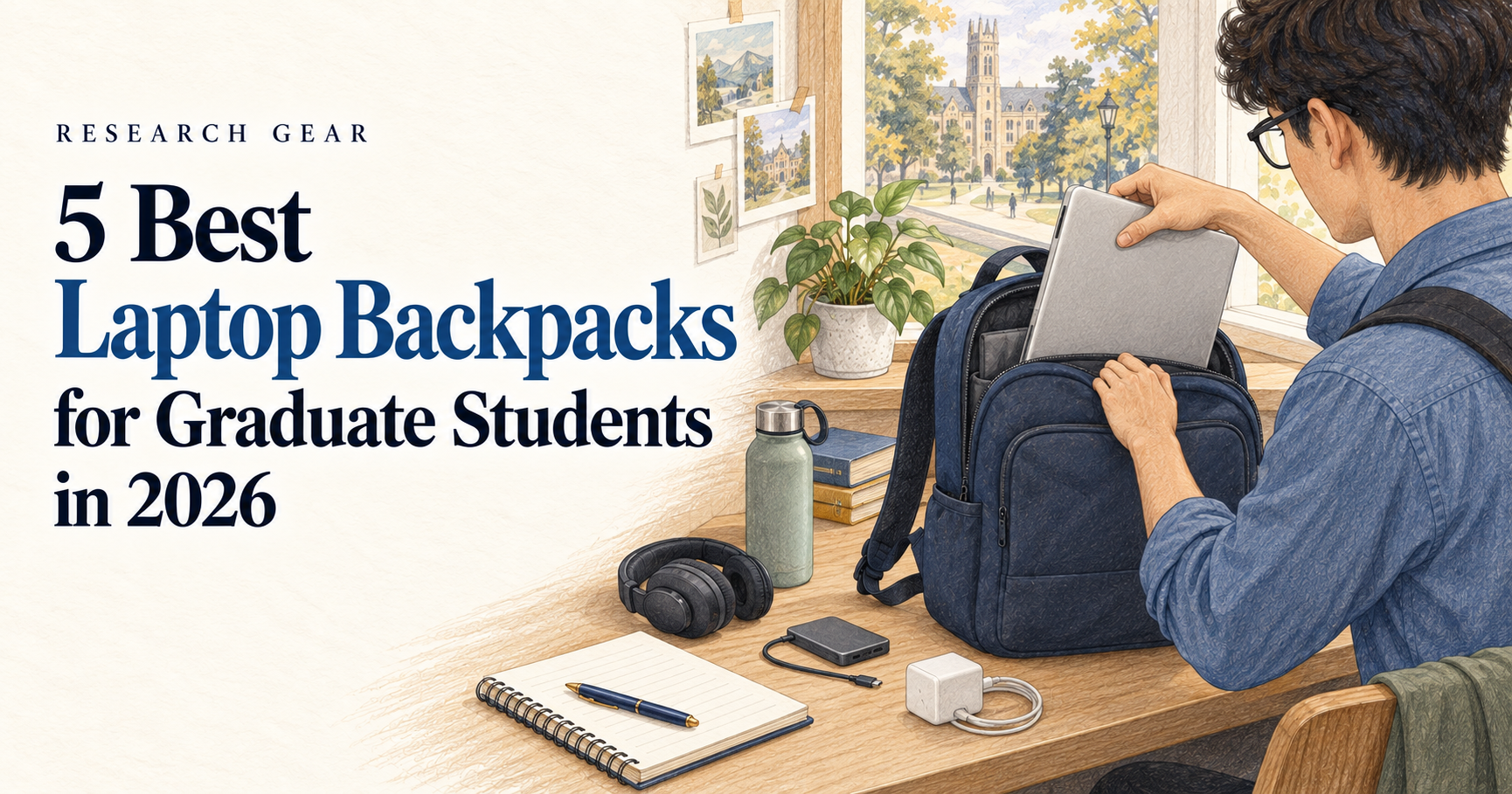
Graduate students often carry much more than just a laptop.
A typical day may involve a laptop, charger, external SSD, headphones, notebook, research papers, water bottle, and sometimes enough gear to move between a lab, classroom, library, and café without going home.
That makes the backpack itself an important part of your everyday research setup.
In this guide, we compare five of the best laptop backpacks for graduate students in 2026, ranging from compact premium work bags to larger backpacks designed for heavy campus loads and academic travel.
We focused on laptop protection, organization, carrying comfort, capacity, travel features, and how practical each backpack is for everyday graduate school.
Disclosure: This article contains affiliate links. As an Amazon Associate, GradToolLab may earn a commission from qualifying purchases at no additional cost to you.
Quick Comparison
| Laptop Backpack | Best For | Capacity | Laptop Fit | Main Advantage |
|---|---|---|---|---|
| Timbuk2 Authority Laptop Backpack Deluxe | Best Overall | Large work-pack capacity | Up to 17″ | Excellent organization and laptop protection |
| Osprey Nebula | Best for Heavy Loads | 32L | Up to 16″ | Comfortable suspension and large capacity |
| SwissGear 1900 ScanSmart | Best for Travel | 31L | Large laptop compartment | TSA-friendly lay-flat design |
| Osprey Proxima 30L | Best for Everyday Campus Use | 30L | Up to 16″ | Campus-focused organization |
| Bellroy Transit Workpack 2nd Ed. | Best Premium | 20L | Up to 16″ | Minimal design with separate work storage |
1. Timbuk2 Authority Laptop Backpack Deluxe — Best Overall
The Timbuk2 Authority Laptop Backpack Deluxe is our best overall choice because it combines laptop protection, organization, comfort, and a professional appearance without becoming a dedicated travel backpack.
Timbuk2 describes it as a high-volume work pack designed around organization. It includes a padded laptop sleeve for laptops up to 17 inches, an internal organizer, padded straps, an air-mesh back panel, and a luggage pass-through. Its exterior is also water resistant, with additional protection around the bottom of the bag.
Why it works well for graduate students
Graduate students often carry several small accessories in addition to a laptop.
For example:
- USB-C charger
- USB-C hub
- Power bank
- External SSD
- Wireless mouse
- Headphones
- Pens and notebooks
- Research documents
A backpack with proper organization can keep those items from becoming one large pile at the bottom of the bag.
The Authority Deluxe is particularly useful if you frequently move between a research lab, library, classroom, and home.
Good for larger laptops
Another advantage is the laptop compartment.
While many backpacks stop at 15 or 16 inches, Timbuk2 states that the Authority Deluxe can accommodate laptops up to 17 inches.
That gives it more flexibility for students using larger engineering, data-science, or workstation-class laptops.
Useful for academic travel too
The luggage pass-through allows the backpack to slide onto the handle of rolling luggage.
That may not matter on an ordinary campus day, but it becomes useful when traveling for conferences, workshops, internships, or research visits.
What to consider
This is not the smallest backpack in the guide.
If you only carry a thin laptop, phone, and one notebook, a slimmer option such as the Bellroy may be more appropriate.
But for students who want one backpack that can handle both daily campus use and occasional travel, the Authority Deluxe offers the best overall balance.
Best for: Graduate students who want one organized backpack for laptops, research gear, commuting, and occasional academic travel.
2. Osprey Nebula — Best for Heavy Loads
The Osprey Nebula is the backpack we would choose for students who regularly carry a lot of equipment.
It offers 32 liters of capacity, a dedicated padded laptop and document section, multiple organization pockets, dual water-bottle pockets, and Osprey’s AirScape back panel.
Osprey lists support for most 16-inch laptops and a weight of roughly 0.96–1.03 kg depending on the current version.
Why 32 liters can be useful in graduate school
Thirty-two liters is considerably more space than a compact work backpack.
That makes the Nebula useful if your normal day includes things such as:
- Laptop
- Charger
- Textbooks
- Printed papers
- Lunch
- Water bottle
- Headphones
- Lab clothing
- Small research equipment
Students who stay on campus from morning until evening may appreciate the extra room more than students who only commute for a few hours.
Carrying comfort matters when the bag gets heavy
Capacity is only useful if the bag remains comfortable once you fill it.
Osprey uses an AirScape back panel and padded harness system derived from its outdoor packs, with ventilation and additional support for everyday carrying.
That makes the Nebula particularly appealing if your backpack regularly becomes heavy.
Better than a simple laptop bag for long days
The Nebula is not as minimalist or formal-looking as the Bellroy.
Instead, its advantage is practicality.
If you carry a laptop plus a large amount of academic gear every day, the extra capacity and outdoor-inspired carrying system may matter more than having the cleanest possible appearance.
Best for: Students who carry a heavy laptop, books, accessories, and other gear during long days on campus.
3. SwissGear 1900 ScanSmart — Best for Travel
The SwissGear 1900 ScanSmart is the most travel-oriented option in this guide.
It combines a 31-liter capacity with a dedicated laptop section, tablet storage, multiple organizer pockets, water-bottle pockets, and a TSA-friendly ScanSmart compartment.
SwissGear lists the bag at 18.5 × 13.25 × 9 inches and approximately 3.3 lb, using durable 1200D polyester.
Why it makes sense for conferences
Traveling to an academic conference usually means carrying more than you would on a normal campus day.
You may need:
- Laptop
- Charger
- Presentation equipment
- Phone
- Power bank
- Travel documents
- Headphones
- Notebook
- Water bottle
- Personal items
The SwissGear has enough separate storage areas to make that setup easier to organize.
ScanSmart is the standout feature
The laptop compartment is designed to lay flat for airport screening.
That does not guarantee that every airport or security officer will let your laptop remain inside the backpack, but the design itself is optimized around airport travel.
For students who travel frequently, that is more useful than it would be in a purely campus-focused backpack.
Lots of organization
The 1900 is not a minimalist backpack.
It has numerous compartments and pockets, which is an advantage if you like giving every cable, adapter, document, and device its own place.
The trade-off is that the bag itself is heavier and bulkier than simpler options.
If you rarely travel and mostly carry a lightweight laptop to class, it may be more backpack than you need.
Best for: Graduate students who regularly fly to conferences, research visits, internships, or academic events.
4. Osprey Proxima 30L — Best for Everyday Campus Use
The Osprey Proxima 30L is one of the most directly student-oriented backpacks in this guide.
Osprey describes it as a campus backpack and gives it 30 liters of capacity, a separate laptop compartment that fits most 16-inch laptops, internal tablet and document sleeves, organizer storage, two water-bottle pockets, and an AirScape back panel.
Designed around student life
Unlike some business backpacks that happen to work well for students, the Proxima is specifically designed around campus use.
That makes its organization particularly relevant to graduate students.
You can separate:
Laptop + tablet + documents + daily accessories
without needing a complicated set of individual cases.
30L is a useful everyday size
The Proxima sits in a useful middle ground.
It has much more capacity than the 20L Bellroy, but it is still slightly smaller than the 32L Nebula.
That makes it suitable for students who carry a moderate-to-large amount of equipment but do not necessarily want the biggest backpack possible.
Comfortable for moving around campus
Osprey uses a lightweight, mesh-covered AirScape back panel designed to provide ventilation and a stable fit against the body.
That can matter if your university campus requires a lot of walking between buildings.
Who should choose it?
The Proxima is probably the easiest recommendation for a traditional campus routine.
If your priority is simply carrying a laptop, documents, water bottle, accessories, and a few personal items every day, it provides a strong balance of capacity and organization.
Best for: Students who want a roomy, comfortable backpack primarily for everyday campus life.
5. Bellroy Transit Workpack 2nd Ed. — Best Premium
The Bellroy Transit Workpack 2nd Ed. takes a different approach from the larger Osprey and SwissGear backpacks.
Rather than maximizing capacity, it focuses on a clean appearance, smart organization, and a more compact 20-liter design.
The version we selected supports laptops up to 16 inches and separates work equipment from the main storage area.
Bellroy’s Transit line emphasizes minimalist exterior design, internal organization, and quick access to everyday items such as laptops and water bottles.
Why it is our premium choice
Graduate school does not only happen in a lab.
You may also attend:
- Industry internships
- Academic conferences
- Interviews
- Meetings with collaborators
- Presentations
- Networking events
In those situations, a backpack that looks more like a professional work bag can be appealing.
The Bellroy has a much more understated design than a traditional school backpack.
Separate work organization
Bellroy designed the Transit Workpack around separating work equipment from the rest of the bag.
Laptop and work accessories can be accessed through their own section, reducing the need to open the entire main compartment when you simply need your computer or cable.
That can be convenient during meetings or while working from cafés and shared spaces.
The main limitation is capacity
At around 20 liters, this is not the backpack for students carrying several textbooks, lunch, lab equipment, a large jacket, and a laptop simultaneously.
Its advantage is the opposite.
It works best for a streamlined setup such as:
Laptop + charger + notebook + headphones + a few accessories
If that describes your daily carry, the smaller size and cleaner design may actually be preferable.
Best for: Graduate students who want a compact, professional-looking backpack for research, meetings, internships, and everyday commuting.
How Much Backpack Capacity Do Graduate Students Need?
Backpack capacity is usually measured in liters.
There is no single ideal size because graduate students have very different routines.
However, the products in this guide illustrate three useful categories.
Around 20L
Best for a minimal everyday setup.
A 20L backpack works well if you mainly carry:
- Laptop
- Charger
- Notebook
- Phone
- Headphones
- A few small accessories
This size is easier to carry on crowded trains and generally looks more compact.
The Bellroy Transit Workpack fits this category.
Around 30L
For many graduate students, around 30 liters is the sweet spot.
It provides enough room for a laptop, accessories, water bottle, papers, and additional everyday items without becoming a large travel pack.
The Osprey Proxima is a good example.
31–32L and above
This range makes more sense if you regularly carry a heavy load or use the same backpack for both campus and travel.
The SwissGear 1900 and Osprey Nebula fit this category.
Laptop Protection Should Be a Priority
Your laptop may be one of the most expensive items you carry every day.
For that reason, we strongly prefer backpacks with a dedicated padded laptop compartment or sleeve.
A laptop should ideally not sit loosely beside textbooks, chargers, bottles, and other hard objects.
Also check the maximum laptop size before buying.
The products in this guide support different sizes, from common 16-inch systems up to larger 17-inch laptops.
Do not assume that every “laptop backpack” fits every laptop.
Organization Matters More Than It Sounds
A backpack with one giant compartment may have plenty of space, but that does not necessarily make it practical.
Graduate students tend to carry a lot of small technology accessories.
For example:
USB-C charger
External SSD
Power bank
Wireless mouse
USB-C hub
Charging cables
Headphones
Without internal organization, these items quickly collect at the bottom of the bag.
Dedicated pockets make it easier to reach the item you need without emptying your backpack onto a library desk.
Comfort Becomes Important on Large Campuses
Backpack comfort is easy to ignore when shopping online.
But if you walk 20 minutes across campus carrying a laptop and several books, shoulder straps and back-panel design matter.
Look for:
- Padded shoulder straps
- Ventilated back panels
- Good weight distribution
- Sternum straps on larger packs
- Adjustable compression straps
This is one reason the Osprey models stand out.
Their backpack design experience extends beyond ordinary laptop bags and into hiking and outdoor packs, which influences their carrying systems.
Do Graduate Students Need a Waterproof Backpack?
Usually, full waterproofing is not necessary.
But some level of water resistance is very useful.
You may eventually walk between campus buildings in unexpected rain while carrying a laptop and research equipment.
A water-resistant exterior provides additional protection, but it should not be treated as permission to expose electronics to heavy rain.
For severe weather, a dedicated rain cover or waterproof laptop sleeve provides additional protection.
Backpack vs Messenger Bag for Graduate School
Messenger bags can look professional and provide quick access to a laptop.
However, backpacks distribute weight across both shoulders.
That becomes increasingly important as the load gets heavier.
If you regularly carry only a lightweight laptop and notebook, either style can work.
But once you add a charger, water bottle, papers, headphones, and other accessories, a backpack is generally more comfortable for longer walks.
Which Backpack Is Best for Commuting?
For ordinary campus commuting, the Osprey Proxima 30L is particularly well balanced.
Its 30-liter capacity gives you room for academic equipment without moving into a particularly large travel bag.
For a more minimal commute, the Bellroy Transit Workpack is a better choice.
And if your backpack is usually heavy, the Osprey Nebula offers more space and a more substantial carrying system.
Which Backpack Is Best for Academic Travel?
For frequent flights, our choice is the SwissGear 1900 ScanSmart.
Its 31-liter capacity, extensive organization, and airport-oriented laptop compartment make it particularly well suited to conferences and research trips.
However, if you want one backpack that looks more professional at both a conference and a meeting, the Timbuk2 Authority Deluxe is another strong option.
Do You Need a 17-Inch Laptop Backpack?
Only if you actually own a large laptop.
Most modern student laptops are 13–16 inches.
However, engineering, simulation, CAD, machine learning, and other technical workloads sometimes lead students toward larger laptops.
If you use a 17-inch device, the Timbuk2 Authority Laptop Backpack Deluxe is particularly worth considering because Timbuk2 officially specifies support for laptops up to 17 inches.
Always compare your laptop’s physical dimensions with the manufacturer’s laptop-compartment specifications before purchasing.
Which Laptop Backpack Should You Buy?
For most graduate students, we recommend the Timbuk2 Authority Laptop Backpack Deluxe.
It combines excellent organization, laptop protection, carrying comfort, water resistance, and travel-friendly features without being specialized for only one use case.
If you carry a large amount of equipment every day, choose the Osprey Nebula.
For conferences and frequent travel, the SwissGear 1900 ScanSmart is the most travel-focused option.
For ordinary campus life, the Osprey Proxima 30L provides an especially practical balance of space and organization.
And if you carry relatively little and prefer a cleaner, more professional appearance, the Bellroy Transit Workpack 2nd Ed. is our premium choice.
The right backpack ultimately depends less on the brand and more on how much equipment you actually carry every day.
FAQ
What size backpack is best for graduate students?
For many students, a backpack around 25–30 liters provides a good balance between capacity and portability.
Students with a minimal setup may prefer around 20 liters, while those carrying books, equipment, or travel items may benefit from 30 liters or more.
Is a 30L backpack too big for university?
Not necessarily.
A 30L backpack is useful if you carry a laptop, charger, papers, water bottle, lunch, and additional accessories.
If you only carry a laptop and notebook, however, it may be larger than necessary.
Should a laptop backpack have a separate laptop compartment?
We recommend it.
A dedicated padded compartment protects the laptop and keeps it separated from chargers, books, bottles, and other equipment.
Is a backpack better than a shoulder bag for graduate school?
For heavier loads and longer walks, usually yes.
A backpack distributes the weight across both shoulders, which tends to be more comfortable than carrying the same load on one side.
What should a graduate student carry in a backpack?
A typical setup may include a laptop, charger, power bank, external SSD, USB-C hub, headphones, notebook, pens, water bottle, and research papers.
The exact setup depends heavily on your research field and working style.
Which laptop backpack is best for graduate students?
For most users, the Timbuk2 Authority Laptop Backpack Deluxe offers the best overall combination of organization, laptop protection, comfort, and versatility.